

What Is Responsible Gambling?

Responsible gambling is a structured approach to betting that limits spending, controls time, and reduces behavioural risk during gambling activity. Responsible gambling tools include deposit limits, loss limits, time limits, session limits, time-outs, self-exclusion schemes, reality checks, and bank or app gambling blocks that create measurable financial and behavioural boundaries.
Responsible gambling on football betting protects financial stability and mental wellbeing by encouraging pre-set budgets, time management, and avoidance of emotional betting. Responsible gambling when betting on football reduces the risk of chasing losses, impulsive in-play wagering, and excessive spending driven by team loyalty or short-term results.
The main warning signs of problem gambling include repeated overspending, borrowing money, secrecy about betting activity, emotional distress after losses, preoccupation with recovering money, and disruption to work or relationships. Seeking professional help for gambling becomes necessary when gambling behaviour leads to financial hardship, emotional strain, repeated failed attempts to cut back, or measurable life disruption. Organisations that help with gambling problems include GamCare, GambleAware, and the National Gambling Helpline in the UK. These organisations provide counselling services, prevention programmes, public education, crisis support, and referral pathways for individuals and families affected by gambling harm.
What Does Responsible Gambling Mean?
Responsible gambling means participating in betting or gaming activities in a way that remains controlled, informed, and within personal limits. Responsible gambling focuses on ensuring that gambling stays a form of entertainment rather than becoming a source of financial, emotional, or social harm. The concept applies both to individual players, who manage their behaviour and spending, and to gambling operators and regulators, who design systems that reduce risk and protect vulnerable users.
Responsible gambling comprises practical tools, regulatory safeguards, and clear communication about risks. In the United Kingdom betting sites typically provide features such as deposit limits, time limits, self-exclusion schemes, reality checks, and account activity statements that allow players to monitor and restrict their own behaviour. Financial institutions in some jurisdictions offer gambling transaction blocks, while regulators impose advertising rules, affordability checks, and age-verification requirements to prevent underage gambling and protect at-risk individuals.
Why Is Responsible Gambling Important When Betting on Football?
Responsible gambling is important when betting on football because it protects your finances and it protects your mental wellbeing. Football betting moves quickly, with multiple matches, in-play markets, and constant promotional offers, which increases the risk of overspending or chasing losses. Responsible gambling helps bettors set clear limits, avoid emotional decisions and make sure the fun of football betting does not tip into a problematic situation that creates stress, loss of control, or financial strain.
The two main benefits of gambling responsibly on football are outlined below.
- Protecting your finances. Protecting your finances means setting deposit limits, defining a fixed betting budget, and avoiding impulsive in-play wagers driven by frustration or excitement. A clear football betting budget makes it easier to separate entertainment spending from essential spending. Financial limits reduce the chance of chasing losses after a late goal, a red card, or an unexpected result changes the course of a match.
- Maintaining your mental wellbeing. Maintaining your mental wellbeing means recognising when football betting stops feeling enjoyable and starts creating stress, anxiety, or compulsive behaviour. Football betting often creates intense emotional swings because results unfold in real time and are closely tied to personal hopes and frustrations. Clear limits, regular breaks, and honest self-monitoring help keep the fun of football betting from turning into a harmful pattern.
Football betting involves strong emotional attachment to teams and outcomes, which increases the temptation to double stakes after a loss or to bet beyond planned limits. Responsible gambling keeps football betting structured, controlled, and sustainable, ensuring that enjoyment of the sport remains separate from harmful betting patterns.
How Do You Gamble Responsibly?
Responsible gambling involves setting clear financial limits, setting strict time limits, avoiding loss chasing, understanding your motivations, and maintaining balance outside gambling. These measures help keep gambling as controlled entertainment rather than a source of financial or emotional harm.
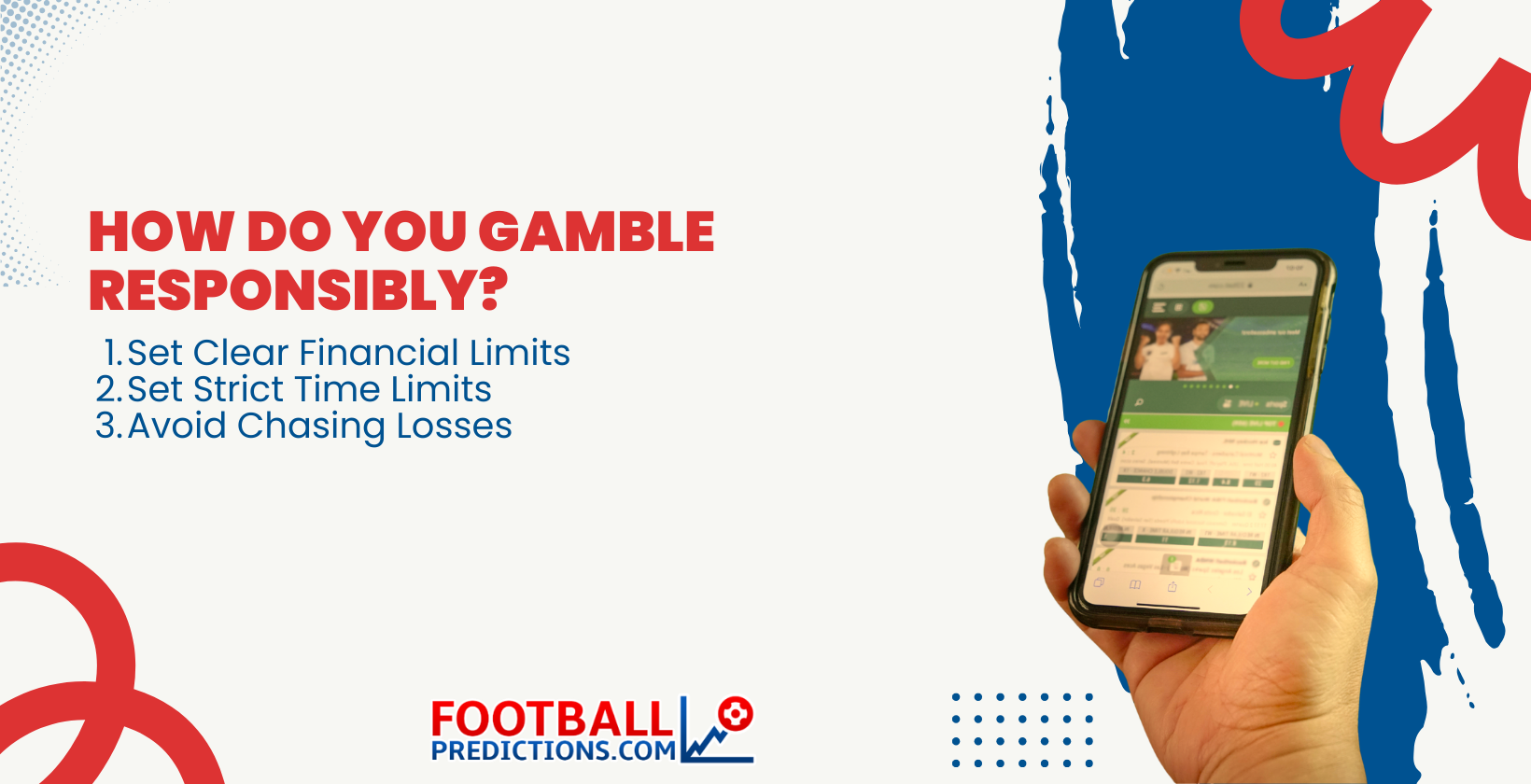
More information about the 5 main steps to gamble responsibly is given below.
- Set Clear Financial Limits. Decide in advance how much money you are prepared to spend over a defined period, whether daily, weekly, or monthly. Setting a financial limit protects your essential expenses and prevents impulsive deposits after losses.
- Set Strict Time Limits. Determine how long you will dedicate to gambling before you begin. Ending the session when the time limit expires reduces fatigue and limits emotionally driven decisions.
- Avoid Chasing Losses. After you’ve reached your spending limit or experienced a loss, accept the result and walk away. Attempting to recover losses by increasing stakes often leads to larger financial damage and loss of control.
- Understand Your Motivation. Once you’ve established limits around money and time, reflect on why you are gambling. Identifying whether gambling serves entertainment rather than emotional escape helps maintain healthy boundaries.
- Maintain Life Balance. Ensure gambling remains one small part of a broader routine that includes work, relationships, and hobbies. Maintaining life balance reduces dependency and supports long-term control over gambling behaviour.
How To Set a Gambling Budget?
To set a gambling budget, start by deciding in advance how much disposable income you are willing to spend over a fixed period and committing to that amount as a non-negotiable limit. Your gambling budget should come only from money that remains after covering essential expenses such as rent, bills, food, and savings, and it should never rely on credit, borrowing, or future income. A gambling budget works best when it is specific, time-bound, and clearly separated from everyday funds, whether through a dedicated account or a strict deposit limit. Treating your gambling budget as the cost of entertainment rather than an investment protects financial stability and reduces the temptation to increase spending after losses.
Why Should You Never Chase Losses?
You should never chase losses when gambling because chasing losses increases financial damage and reinforces addictive behaviour. Chasing losses violates basic probability, as each new bet remains independent of previous outcomes, which means increasing stakes does not improve your chances of recovering money. Instead, loss-chasing behaviour often leads to larger and faster losses, emotional decision-making, and a pattern of frustration that pushes you to bet beyond your original limits. Over time, this pattern of escalating bets and mounting losses turns entertainment into financial stress and emotional strain, making it harder to stop and increasing the risk of long-term gambling harm.
How Can You Treat Betting as Entertainment Rather Than Income?
You can treat betting as entertainment rather than income by setting a fixed budget, accepting losses as part of the experience, and separating gambling money from essential finances. Betting becomes entertainment when the money spent is viewed as the cost of leisure, similar to paying for a concert or a sporting event, rather than as a strategy to generate profit. Accepting that losses are statistically more likely than consistent winnings when gambling reinforces realistic expectations and reduces pressure to recover money. Keeping gambling funds distinct from rent, bills, savings, and long-term financial goals prevents betting from becoming a financial dependency and helps maintain control over spending decisions.
What Are the Warning Signs of Problem Gambling?
Two of the main warning signs of problem gambling are reporting unclear money problems or debts and strong behavioural changes. In addition to these signs, research supports two observable indicators of problem gambling. In a large Australian study by Paul Delfabbro, Anna Thomas, and Andrew Armstrong, titled Observable Indicators and Behaviours for the Identification of Problem Gamblers in Venue Environments, published in the Journal of Behavioural Addictions in 2016, problem gamblers were significantly more likely to display intense emotional reactions and noticeable declines in grooming or appearance.
More information about the 4 main warning signs of problem gambling is provided below.
- Reporting unclear money problems or debts: People experiencing problem gambling often struggle to explain where their money has gone, fall behind on payments, or build up debts linked to repeated betting. Financial pressure usually becomes visible through borrowing, missed bills, or frequent money-related stress.
- Strong behavioural changes: Strong behavioural changes may include secrecy, irritability, restlessness, withdrawal from normal routines, or unusual shifts in mood around gambling activity. These behavioural changes often become more noticeable as gambling starts to take priority over daily responsibilities and relationships.
- Intense emotional reactions: Intense emotional reactions involve unusually strong anger, frustration, distress, or agitation during or after gambling. These emotional reactions often reflect a reduced ability to manage losses, disappointment, or uncertainty in a healthy way.
- Declines in grooming or appearance: Declines in grooming or appearance refer to visible reductions in personal care, neatness, or general self-presentation. Changes in grooming or appearance may suggest that gambling problems are affecting daily structure, motivation, and overall wellbeing.
How Do You Know if Gambling Is Becoming a Problem?
You typically know that gambling is becoming a problem when betting no longer feels fully controlled and starts causing financial, emotional, or practical harm in everyday life. Common signs of problem betting include spending more than planned, struggling to stop, thinking about gambling constantly, chasing losses, hiding betting activity, or noticing that gambling is affecting work, relationships, mood, or bills.
Loss of control in betting appears when betting sessions last longer than planned, spending exceeds predefined limits, or repeated attempts to cut back fail. Negative consequences in daily life include financial strain, missed work obligations, relationship conflict, secrecy about gambling activity, and emotional distress such as anxiety or depression after losses. Persistent preoccupation with gambling, frequent thoughts about recovering money, and prioritising betting over responsibilities further indicate that recreational gambling has shifted into harmful gambling behaviour.
What Emotional or Financial Red Flags Should You Watch For?
Emotional or financial red flags in gambling include persistent emotional distress linked to gambling and escalating financial risk-taking beyond personal limits. Emotional red flags involve feelings of anxiety, shame, irritability, depression after losses, secrecy about betting activity, or using gambling to escape stress. Financial red flags include repeatedly exceeding spending limits, borrowing money to gamble, chasing losses, hiding bank statements, or prioritising betting over essential expenses.
Psychological research on red flags in harmful relationships helps clarify how warning signs function more broadly. In an article titled Red flags: Is there any science to spotting a toxic relationship?, published in BBC Science Focus in 2022, Dr Christian Jarrett explains that harmful patterns often become visible through repeated emotional distress, coercive behaviour, and negative health consequences. Although Jarrett discusses relationship dynamics rather than gambling, the same principle applies to gambling harm. Recurring emotional strain, behavioural secrecy, and measurable life disruption signal that gambling behaviour has moved beyond entertainment into a pattern associated with psychological and financial risk.
Which Tools Help To Gamble Responsibly?
In the UK, responsible gambling tools available through UKGC-licensed betting sites often include operator-level deposit limits, time-out features, reality checks, and self-exclusion, while wider tools such as GAMSTOP, gambling-blocking software, and bank card blocks add another layer of control.
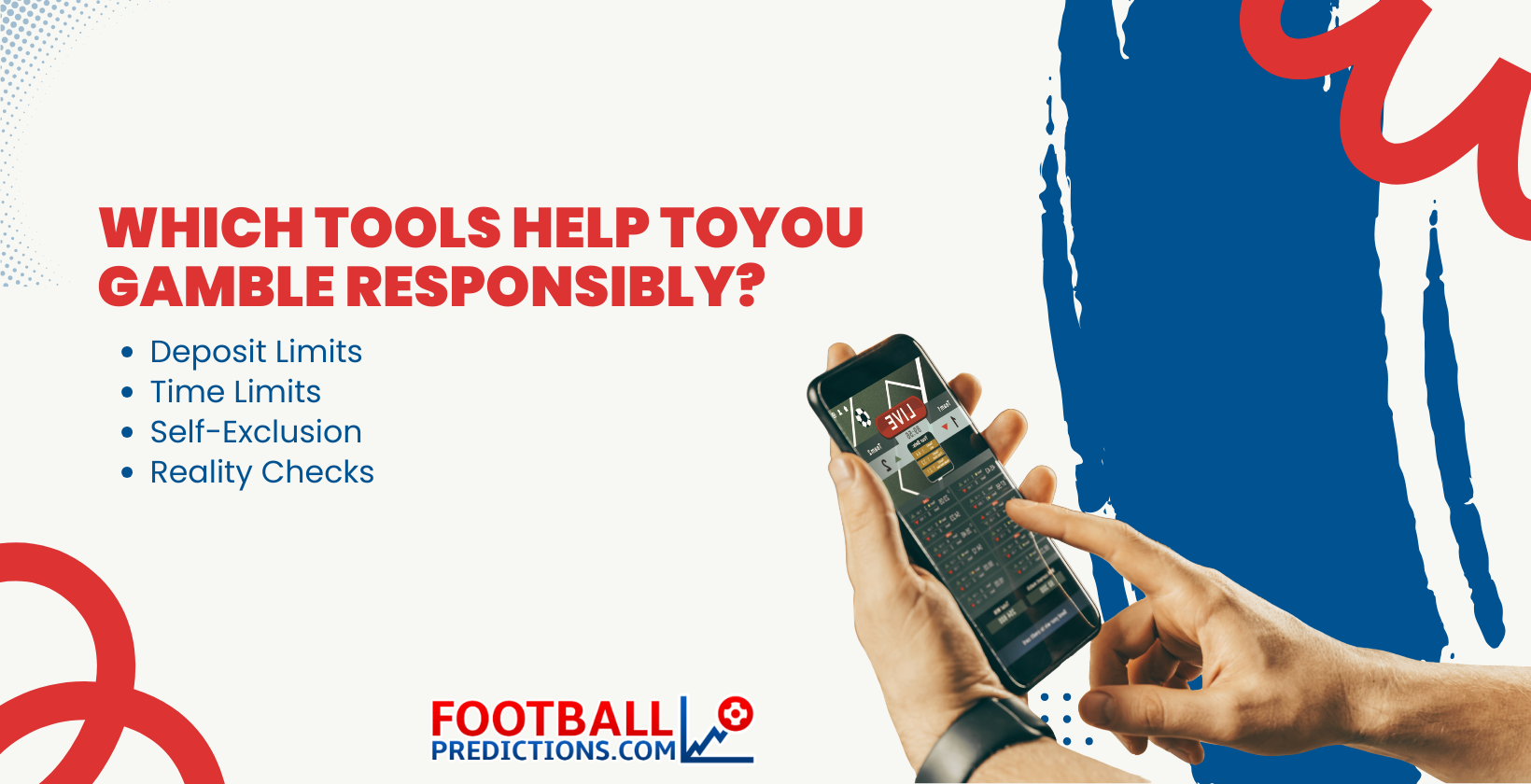
More information about the 7 most useful responsible gambling tools is given below.
- Deposit Limits. These limits cap how much money enters a betting account over a daily, weekly, or monthly period, which helps bettors stay within a defined budget and reduces the risk of overspending.
- Time-Out Features. A time-out temporarily blocks access to a gambling account for a short cooling-off period, giving bettors space to step away when betting starts to feel too frequent or emotionally driven.
- Reality Checks. Automatic reminders appear during a gambling session to show how long the session has lasted or how much has been spent, which helps restore awareness before play becomes excessive.
- Self-Exclusion. This measure blocks access to a betting account for a longer fixed period and is designed for situations where gambling behaviour feels difficult to control through lighter tools alone.
- GAMSTOP. Rather than applying to just one operator, GAMSTOP is a national self-exclusion scheme that prevents access to multiple participating online gambling sites in the UK at the same time.
- Gambling-blocking software. Specialist blocking tools work at device level by restricting access to gambling websites and apps, which adds a practical barrier outside the betting account itself.
- Bank card blocks. Some banks let customers block gambling transactions on debit cards, which helps stop deposits before money reaches the betting account and adds an extra layer of financial control.
What Are Deposit and Loss Limits?
Deposit limits are pre-set caps on how much money you can add to your gambling account within a specific period, while loss limits are pre-set caps on how much money you are allowed to lose within that same timeframe.
More details about how deposit limits and loss limits work follow below.
- Deposit limits. Deposit limits restrict the amount of new money that enters your account over a daily, weekly, or monthly period. That financial boundary helps control spending in advance and reduces the risk of impulsive top-ups after losses, frustration, or extended betting sessions.
- Loss limits. Loss limits restrict how much money you are allowed to lose over a set period before further betting is blocked or limited. That built-in loss threshold creates a stronger backstop against repeated chasing behaviour and helps stop cumulative losses from growing beyond the level you set.
What Are Time-Outs and Session Limits?
Time-outs are temporary suspensions that block access to your gambling account for a short, defined period, while session limits are pre-set caps on how long you can remain logged in or actively betting during a single session.
More details about how time-outs and session limits work follow below.
- Time-outs. A time-out blocks access to your gambling account for a short cooling-off period, which helps interrupt repetitive betting and creates distance from impulsive or emotionally driven decisions. That temporary account restriction is designed for short-term control rather than long-term exclusion.
- Session limits. A session limit sets a maximum length for a gambling session and ends betting activity once the allocated duration has been reached. That time-management tool helps reduce fatigue, loss of awareness, and the gradual extension of gambling beyond the original plan.
What Is Self-Exclusion and How Does It Work?
Self-exclusion is a formal responsible gambling measure that works by allowing a player to voluntarily block access to gambling accounts for a fixed or permanent period, during which operators must prevent login access and marketing communication. Self-exclusion usually applies for a defined minimum period and is designed for situations where lighter tools such as deposit limits or time-outs are no longer enough to control gambling behaviour. During the self-exclusion period, the account must remain inaccessible, the player must not receive promotional material, and normal betting activity must not be allowed to resume until the exclusion period has ended. Self-exclusion from betting strengthens behavioural control by creating a mandatory barrier that removes immediate gambling access and supports long-term harm prevention.
How Can Bank or App Gambling Blocks Help?
Bank or app gambling blocks help by preventing gambling-related transactions from being processed through your debit card or digital banking account.
Bank or app gambling blocks strengthen financial control by creating an external safeguard that reduces impulsive deposits and supports adherence to personal gambling limits.
What Should You Do if You Think You’re Gambling Too Much?
You should pause gambling activity, review your financial records, activate responsible gambling tools, and seek professional support if you think you’re gambling too much.
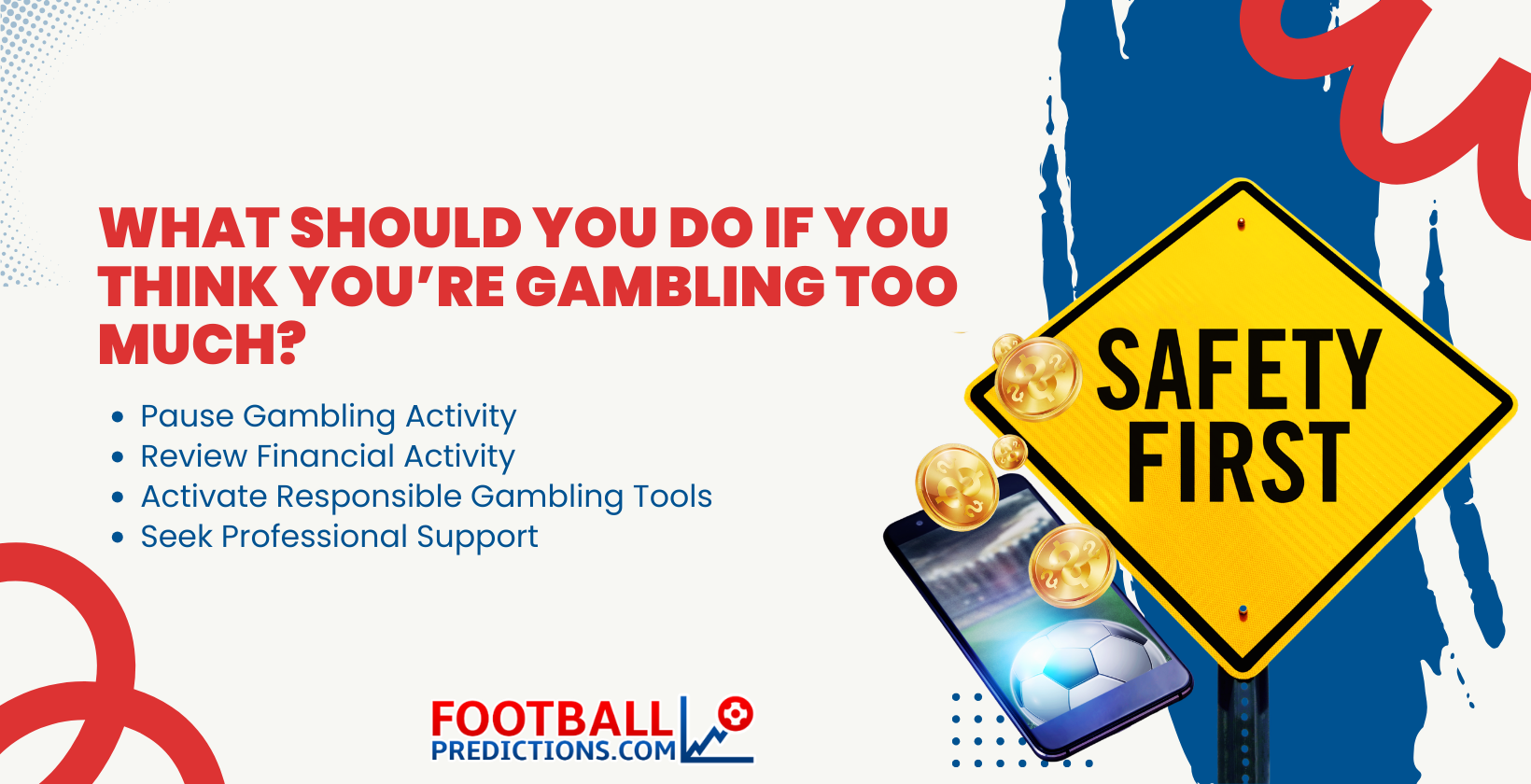
More information about the 4 main steps to reduce gambling harm is provided below.
- Pause Gambling Activity. Stop gambling immediately to interrupt ongoing losses and create mental space for clearer decision-making.
- Review Financial Activity. Examine recent deposits, withdrawals, and total gambling expenditure to understand the full financial impact of gambling behaviour.
- Activate Responsible Gambling Tools. Set deposit limits, apply time limits, or initiate self-exclusion to create structured barriers against continued betting.
- Seek Professional Support Contact a gambling support service, counsellor, or helpline for confidential advice and structured assistance.
When Should You Seek Professional Help for Gambling?
You should seek professional help for gambling when gambling behaviour leads to financial hardship, emotional distress, relationship conflict, or repeated failed attempts to cut back. Professional support becomes necessary when gambling causes loss of control, persistent preoccupation with betting, or significant disruption to work, health, or daily responsibilities.
In the UK, professional help for gambling is available through services such as GamCare, which offers confidential support by phone, live chat, WhatsApp, and online community support for people affected by gambling, including friends and family members. In cases where urgent emotional support is needed and GamCare is not immediately available, people in the UK often contact Samaritans on 116 123, HOPELineUK on 0800 068 4141 for those under 35, or emergency services on 999 in an emergency.
Can You Block Yourself From All UK Gambling Sites?
Yes, you can block yourself from all UK gambling sites by registering with a national self-exclusion scheme such as GAMSTOP, which prevents access to all UK-licensed online gambling operators. National self-exclusion schemes work by requiring licensed operators to deny account access and marketing communication for the selected exclusion period.
Which Organisations Can Help With Gambling Problems?
GamCare, GambleAware, and the National Gambling Helpline are three key organisations that provide support for people experiencing gambling harm in the UK. These three gambling support services help people access advice, treatment, prevention resources, and immediate confidential support at different stages of gambling-related harm.
More information about the 3 main organisations that offer help with gambling problems in the UK is given below.
- GamCare. GamCare provides direct support services for people affected by gambling harm, including free counselling, structured treatment programmes, live chat, and practical guidance for individuals, friends, and family members.
- GambleAware GambleAware focuses on public-health work around gambling harm by funding research, education, prevention activity, and access routes into evidence-based support and treatment services.
- National Gambling Helpline. The National Gambling Helpline offers confidential advice and crisis support 24 hours a day for people worried about their own gambling or the gambling behaviour of someone close to them.
What Support Does GamCare Provide?
GamCare provides free counselling, structured treatment programmes, and practical advice for individuals affected by gambling harm. GamCare delivers support through online chat, telephone counselling, face-to-face sessions, and digital recovery tools designed to reduce gambling-related risk.
What Is GambleAware?
GambleAware is an independent charity that funds research, education, and treatment services aimed at preventing and reducing gambling harm. GambleAware works with healthcare providers and support organisations to develop evidence-based programmes and public awareness campaigns.
What Is the National Gambling Helpline?
The National Gambling Helpline is a confidential support service available 24 hours a day for people concerned about gambling behaviour. The National Gambling Helpline offers immediate advice, emotional support, and referrals to specialist treatment services across the UK.
How Can Friends or Family Support Someone With Gambling Issues?
Friends or family can support someone with gambling issues by encouraging open conversation and by helping establish practical financial boundaries. Encouraging open conversation reduces secrecy and shame, creating a safe space where gambling behaviour can be discussed without judgment and where early intervention becomes possible. Helping establish practical financial boundaries, such as monitoring spending, limiting access to funds, or supporting the use of self-exclusion tools, strengthens accountability and reduces the risk of continued financial harm.