
90 Minutes Play

In football betting, the 90 minutes play rule means that all bets are settled based on the result at the end of the standard 90 minutes of play, including any stoppage time added by the referee. This rule excludes extra-time and penalties, which are only applicable in knockout stages or when the match is tied at full-time.
The 90 minutes play rule applies to key betting markets like Match Result, Correct Score, First/Last Goalscorer, Over/Under Goals, and Both Teams to Score (BTTS). For example, a bet on Over 2.5 Goals would require three goals to be scored during the 90 minutes of play and stoppage time – goals scored in extra-time or penalties don’t count.
The rule is particularly important in knockout competitions such as the Champions League or domestic cup tournaments, where extra-time or penalties can decide the outcome. For instance, a bet on Match Result will be voided if the game ends in a draw at 90 minutes, even if one team wins in extra-time or penalties.
Bookmakers use the 90 minutes play rule to maintain consistency across various markets, making it clear when and how bets are settled. It helps with risk management, as outcomes after extra-time are potentially unpredictable and harder to price. The rule offers clarity for bettors, ensuring that they know exactly when their bets will be settled – after the first 90 minutes, with stoppage time included, but no extra-time or penalty shootouts.
Before placing a 90 minutes play bet, always check for “90 mins only” disclaimers on your sportsbook. Some markets, like “To Qualify” or “To Lift the Cup”, sometimes include extra-time and penalties, so it’s crucial to understand the terms of each market.
The 90 minutes play rule ensures that all bets are settled fairly and consistently, helping bettors make informed decisions without confusion over extra-time results.
Table of Contents
What Does 90 Minutes Play Mean in Sports Betting?
The “90 minutes play” rule in sports betting means that all bets are settled based on the result at the end of the standard 90 minutes of a football match, including any stoppage or injury time added by the referee. The 90 minutes play rule excludes extra time and penalty shootouts that follow matches in knockout competitions.

For example, a bet on England to beat Germany results as a loss when the score shows 1-1 after 90 minutes plus stoppage time, even though England wins on penalties later. Another common example is seen in markets such as “Over 2.5 Goals”, which requires three goals during the standard period to win, regardless of any additional goals scored after the full-time whistle. The 90-minute play rule is crucial in competitions like the World Cup or Champions League, where matches often extend beyond 90 minutes, while bets on standard markets close once the referee signals the end of normal time.
Which Betting Markets Follow the 90 Minutes Play Rule?
Many football betting markets follow the 90 minutes play rule, with bets settled based on the score at the end of 90 minutes plus stoppage time. The main markets subject to the 90 minutes play rule are Match Result, Correct Score, First/Last Goalscorer, Over/Under Goals and Both Teams to Score (BTTS).
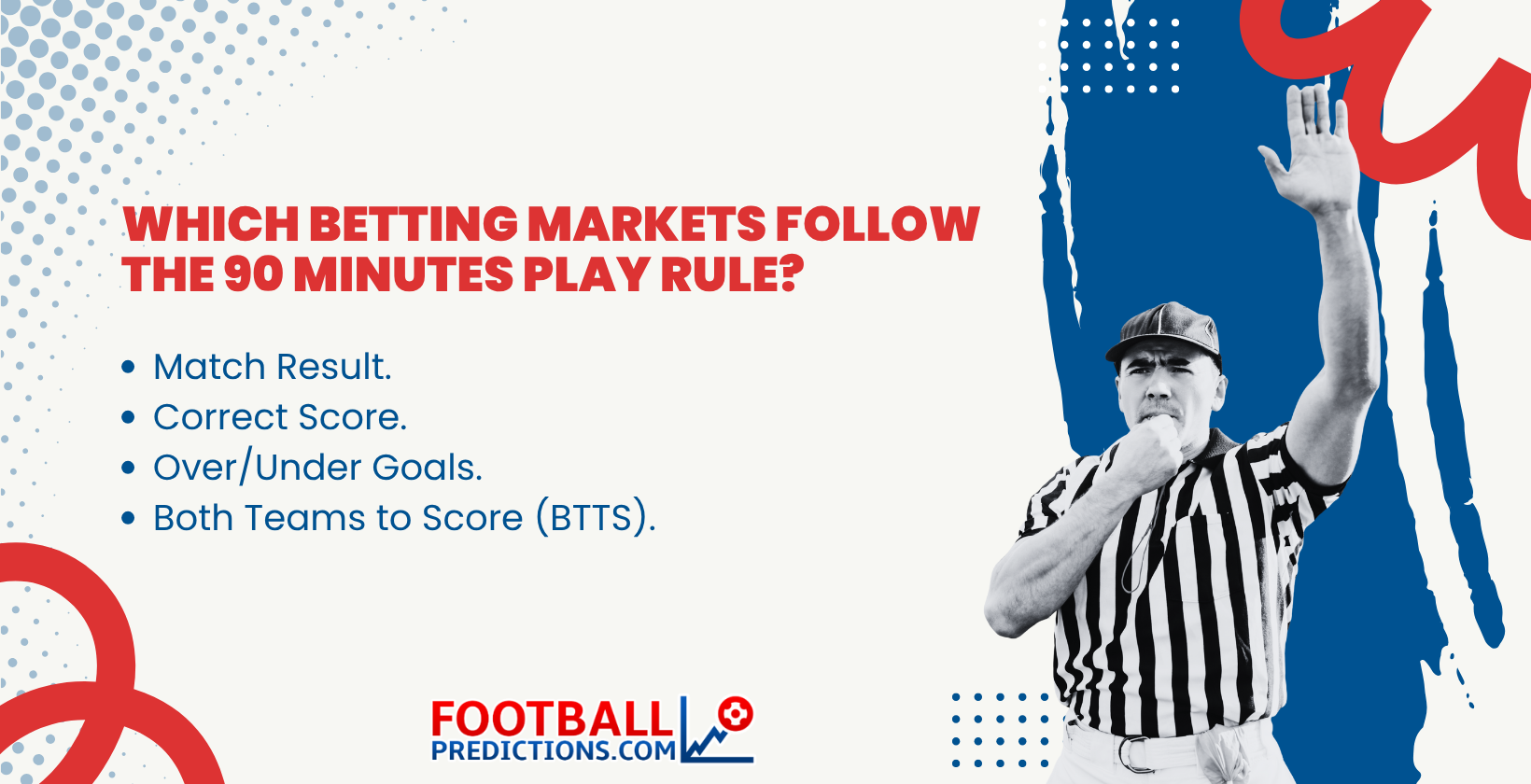
More information on the 5 top markets affected by the 90 minutes play rule follows below.
- Match Result. Match Result is the most common football betting market. Match Result bets settle based on the home win, draw or away win outcome at the end of 90 minutes plus stoppage time, with results after extra time or penalties excluded.
- Correct Score. Correct Score involves predicting the exact final score. These bets settle based on the result after 90 minutes, with goals during extra time or penalties not included.
- First/Last Goalscorer. First/Last Goalscorer markets track who scores the first or last goal during the match. A First or Last Goalscorer bet is settled based on goals scored during the standard 90 minutes plus stoppage time, excluding goals in extra time.
- Over/Under Goals. Over/Under Goals betting involves predicting if the total goals in the match will finish over or under a line, such as Over 2.5 Goals. Over/Under Goals outcomes consider only goals scored during the 90 minutes plus stoppage time, ignoring any goals scored once the full-time whistle sounds.
- Both Teams to Score (BTTS). Both Teams to Score, or BTTS, requires both teams to score during the match. BTTS bets settle based on goals scored in the 90 minutes plus stoppage time, with any goals after full-time not counted for settlement.
The 90 minutes play rule keeps the settlement of these markets aligned with the official match time, helping bettors plan and manage their strategies with clear cut-off points for market results. While many markets are affected by the 90-minute play rule, this rule is not applicable to every market. For example Outright Winner markets settle based on the final result after extra time or penalties when required. Outright Winner markets consider the team that advances or wins the trophy, regardless of the score at the end of the standard 90 minutes, making them different from markets affected by the 90 minutes play rule.
Why Do Bookmakers Use 90 Minutes Play Rules?
The three main reasons bookmakers use the 90 minutes play rule in football betting are clarity in cup matches, risk management, and consistency across markets. This rule clarifies when bets are settled and aligns how different bet types are evaluated in both league and cup matches.
More information about the 3 main reasons bookmakers use the 90 minutes play rule is given below.
- Clarity in Cup Matches. The 90 minutes play rule ensures clear settlement of bets in cup games that proceed to extra-time and penalties. Cup fixtures introduce scenarios where a team wins after extra-time, but the bet counts only the score at the end of 90 minutes, which otherwise tends to cause confusion for bettors. Applying this rule in cup matches helps bettors understand when their bets are evaluated, avoiding disputes when outcomes change after regular time.
- Risk management. Limiting bets to the first 90 minutes plus stoppage time helps bookmakers manage exposure to unpredictable extra-time scenarios. Extra-time often has different dynamics, with tired players and open tactics, which often distorts pricing if included. Using the 90 minutes rule allows bookmakers to maintain balanced books and clear liability across all football markets.
- Consistency across markets. Bookmakers apply the 90 minutes rule to align markets like match result, Both Teams to Score, and Anytime Scorer under the same time frame. Bettors know what period their bets cover, avoiding inconsistencies such as a match result bet losing while a scorer bet wins due to an extra-time goal. This consistency ensures bets are settled under the same conditions, protecting both bookmakers and punters.
What Should You Check Before Placing a 90 Minutes Play Bet?
The three main things to check before placing a 90 minutes play bet are disclaimers on your sportsbook, the terms of the market you are betting on, and player or team news that affects the match within regular time.
More information about the 3 main things to check before placing a 90 minutes play bet is given below.
- Look for “90 mins only” disclaimers. Check your sportsbook’s market description to confirm if the bet is settled at the end of 90 minutes plus stoppage time. These disclaimers typically say “All bets settled on 90 minutes play only” or “Excludes extra-time and penalties.”
- Check whether the market includes extra-time or not. Some markets, like “To Qualify” (which pays out when a team advances, regardless of how) or “To Lift the Cup” (which settles on the team that wins the trophy by any method), are settled after extra time and thus do not follow the 90-minute play rule. Always verify the specific time frame your chosen market covers to avoid confusion.
- Check player and team news before the match. Line-ups, injuries, and suspensions impact match outcomes, but they hold particular importance for 90 minutes play bets, where there is no extra-time to recover from a slow start or a key absence. Reviewing team form and confirmed starters helps ensure your bet aligns with how the match is likely to unfold within regular time.
Is injury time included in 90-minute football betting?
Yes, injury time is included in 90-minute football betting. Injury or stoppage time is the additional time added by the referee at the end of each half to account for delays during the match, such as substitutions or injuries. Injury time is different from extra-time, which refers to the additional 30 minutes played in knockout games when the score is level after 90 minutes and stoppage time. Bets placed under the 90-minute rule are settled based on the result at the end of regular time plus stoppage time but do not consider extra-time or penalties.
Does extra time count in 90 minutes betting?
No, extra time does not count in 90-minute betting. The 90-minute rule covers the full 90 minutes of regular play plus any stoppage time added by the referee but excludes any extra 30-minute period played in knockout competitions when matches are tied. As a result, bets on match results, correct scores, and most other markets are settled when the referee blows the whistle at the end of regular time and stoppage time, regardless of what happens during extra-time.
Does 90 minutes play include stoppage time?
Yes, 90 minutes play includes stoppage time added by the referee at the end of each half to compensate for time lost due to substitutions, injuries, or other interruptions. This stoppage time is part of the official duration used for settling bets under the 90-minute rule. It is important to distinguish this from extra-time, which is a separate period played in knockout games when the score is tied after regular time and stoppage time, and is not included in 90 minutes betting.
What are the exceptions to the 90-minute play rule?
Exceptions to the 90-minute play rule typically involve special markets or bookmaker-specific rules in knockout stages. Markets such as “To Qualify” or “To Lift the Cup” consider extra-time and penalties, settling based on which team advances, regardless of the result at 90 minutes. In addition to special markets, some bookmakers offer specific bets on outcomes after extra-time or penalties, and these are settled differently from standard 90-minute markets. It is important to review the terms of the market you are betting on to understand when the 90-minute rule applies and when it does not.
What happens to your bet if a match goes to penalties?
If a match goes to penalties, your bet is settled based on the result at the end of 90 minutes plus stoppage time, not including the penalty shootout. The bet is recorded as a draw under the 90-minute rule when the score remains level at the end of regular time, even when the team later wins on penalties. The outcome of the penalty shootout has no impact on bets placed under the 90-minute play rule.
What happens to my 90 minutes play bet if the match is postponed?
If a match is postponed, bets placed under the 90 minutes play rule are typically voided unless the match is rescheduled and played within the bookmaker’s allowed timeframe, which is often 48 or 72 hours. Your bet will usually be refunded if the match is not rescheduled within this period. For more information on how matches postponed are handled by bookmakers, it’s important to check the specific rules of your sportsbook, as policies typically vary depending on the competition or market.