

Fibonacci Football Betting System


Fibonacci is a betting strategy where the bettor increases their stake after every loss by following a predefined numerical sequence in order to recover previous losses and secure a small profit once a single bet wins.
The Fibonacci system applies the well-known Fibonacci sequence (1, 2, 3, 5, 8, 13, 21, and so on) where each number is the sum of the two preceding ones. Applied as a betting strategy, the bettor increases their stake by moving one step forward in the sequence after each loss. Once a bet wins, they step back two positions. This progression allows for gradual stake increases during losing streaks and aims to recover all prior losses plus a small profit with a single win, offering a slower escalation than systems like Martingale.
The steps to use Fibonacci as a betting system in football involve starting with a fixed base stake, advancing one step in the Fibonacci sequence after every loss, and stepping back two positions after a win to continue the cycle.
The main advantages of the Fibonacci betting system are its gradual stake progression and its structured, rule-based approach that removes emotion from decision-making. While the slower increases help preserve the bankroll in the early stages, the main drawbacks of Fibonacci are the extended recovery needed during long losing streaks and the difficulty of applying the system consistently in football markets, where even-money odds are uncommon.
Table of Contents
What is the Fibonacci system?
The Fibonacci system is a betting strategy where the stake increases after each loss based on a predefined numerical sequence. The goal of the Fibonacci system is to recover previous losses and secure a small profit when a single bet wins.

In football betting, Fibonacci is applied to markets with near-even odds, typically just above or below 1/1 (2.00 in decimal). These markets include options like Match Result draws or Both Teams to Score, where there are only two possible outcomes (win or lose) with probabilities generally close to 50%. The bettor starts with a base stake and follows the Fibonacci sequence. This sequence is built by adding each number to the one that came before it, which results in a progressive pattern (1, 1, 2, 3, 5, 8, 13, and so on). Each loss pushes the bettor one step forward in the sequence, while each win moves the bettor two steps back. Unlike the Martingale system, where the stake doubles after every loss and grows rapidly, the stake growth is more gradual under a Fibonacci system. The gradual approach of Fibonacci reduces exposure in the early stages of a losing streak. The method aims to recoup previous losses without relying on large jumps in stake size, making it one of the more manageable betting systems for bettors with limited bankrolls.
How does Fibonacci betting work?
Fibonacci is a betting system that works by increasing the stake after every losing bet, following a specific numerical pattern known as the Fibonacci sequence. After each loss, the bettor moves one step forward in the sequence, and after a win, they step back two positions, continuing this pattern throughout the betting cycle.
Each number in the Fibonacci sequence represents a unit, and the bet amount is calculated by multiplying the unit by the chosen base stake. For example, a bettor starting with £10 would follow a pattern of £10, £10, £20, £30, £50, and so on. The idea is to recover all previous losses with a single win, while limiting stake inflation early in the cycle. The system relies on consistent odds near evens and disciplined stake tracking. In football markets, Fibonacci is commonly used on draws due to their high odds and perceived unpredictability.
The table below illustrates how Fibonacci betting works when applied to a football draw market using a base stake of £1 and odds of 1/1 (2.00 in decimal). The chart tracks the results, stake progression, and balance over a 11-bet sequence under the Fibonacci system.
| Bet Number | Units / Stake | Result | Profit/Loss | Balance |
|---|---|---|---|---|
| 1 | 1 Unit / £1 | Lost | -£1 | -£1 |
| 2 | 1 Unit / £1 | Lost | -£1 | -£2 |
| 3 | 2 Units / £2 | Lost | -£2 | -£4 |
| 4 | 3 Units / £3 | Lost | -£3 | -£7 |
| 5 | 5 Units / £5 | Won | +£5 | -£2 |
| 6 | 2 Units / £2 | Lost | -£2 | -£4 |
| 7 | 3 Units / £3 | Lost | -£3 | -£7 |
| 8 | 5 Units / £5 | Lost | -£5 | -£12 |
| 9 | 8 Units / £8 | Won | +£8 | -£4 |
| 10 | 3 Units / £3 | Won | +£3 | -£1 |
| 11 | 2 Units / £2 | Won | +£2 | +£1 |
In this Fibonacci betting example, each stake is based on units, where 1 unit equals a fixed base amount such as £1. The numbers follow the Fibonacci sequence (1, 1, 2, 3, 5, 8, and so on), where each number is the sum of the previous two. After every loss, the bettor moves one step forward in the sequence to increase the stake. After a win, the bettor steps back two positions. The purpose of stepping back is to recover losses gradually while protecting the bankroll from excessive stake inflation.
The Fibonacci system eventually brings the bettor into profit after multiple ups and downs. By continuing the pattern patiently and applying the correct stake following each result, the bettor moves from a significant £12 loss to a £1 profit by bet number 11. The win in bet 11 demonstrates how the strategy gradually narrows the deficit following a series of losses and partial recoveries. Fibonacci offers slower but steadier recovery compared to more aggressive systems, with low risk of exponential stake jumps and eventual balance restoration through multiple smaller wins.
How do you bet using the Fibonacci system?
To use the Fibonacci system effectively in football betting, you need to follow a clear and disciplined structure. The three essential steps to follow the Fibonacci system correctly involve starting with a fixed base stake, following the Fibonacci sequence after each losing bet, and moving back two steps in the sequence after each win.
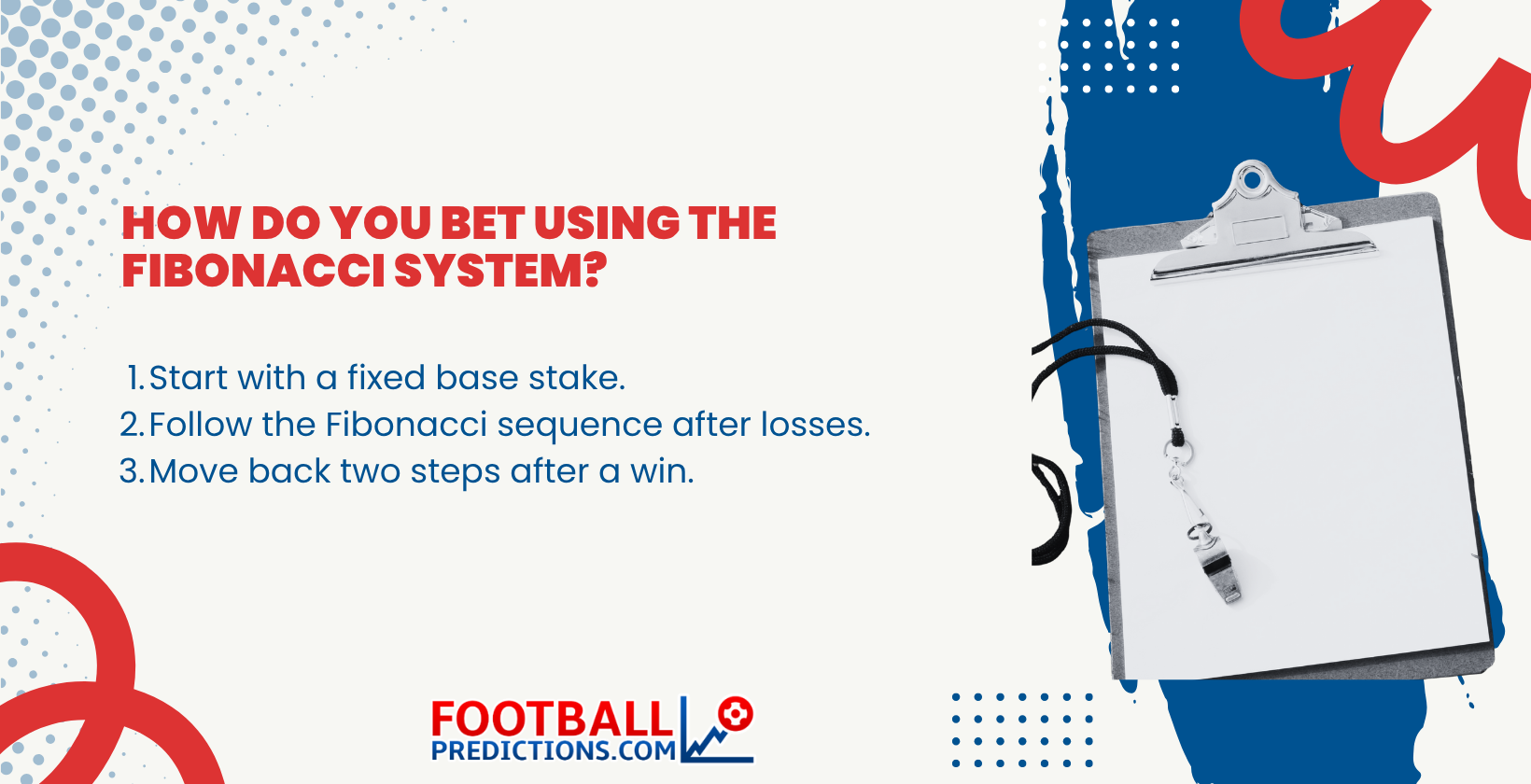
More information about the 3 key steps required to place a bet using the Fibonacci system in football betting is given below.
- Start with a fixed base stake. First, choose a base unit that fits your bankroll and stick to it throughout the sequence. For example, setting £10 as your base stake means all future bets will be multiples of £10 according to the Fibonacci pattern. Your first two bets will both be 1 unit, so you will stake £10 for each. Avoid increasing your initial unit unless you are prepared to expose a larger amount over a potential losing streak. The base stake is the foundation of the entire Fibonacci system, so set it carefully and avoid impulsive adjustments.
- Follow the Fibonacci sequence after losses. Next, advance one step forward in the Fibonacci sequence each time you lose. With a £10 base unit, the progression goes £10, £10, £20, £30, £50, £80, £130, and so on. For instance, placing a £10 bet on a Match Result draw and losing it should be followed by another £10 stake on the next draw. A second loss would raise the next stake to £20, then £30 if the third bet fails. This gradual increase helps spread risk more evenly than doubling strategies.
- Move back two steps after a win. After a win, subtract two steps in the Fibonacci sequence and stake the amount indicated by that earlier point. For example, reaching £50 after previous stakes of £20 and £30 and winning at that level means the next bet should drop to £20. This mechanism reduces risk while continuing the cycle. Wins early in the sequence often bring the stake back to the original level. In that case, resume the Fibonacci pattern from the beginning. This step prevents overexposure and helps the bettor recover smoothly during a possible future losing resume.
What are the pros and cons of the Fibonacci system?
The Fibonacci system is a betting method that involves increasing the stake after each loss by following a fixed numerical sequence. The two main advantages of Fibonacci are its slower stake progression compared to Martingale and the structure it offers for disciplined bankroll management, while the two main drawbacks are the continued exposure during long losing streaks and the reliance on even-money odds that are uncommon in football.
An overview of the 2 main pros of Fibonacci follows below.
- Gradual stake increases. The Fibonacci system uses a slower progression than systems like Martingale, which require the bettor to double their stake after every loss. Instead, Fibonacci increases stakes according to a numerical sequence where each number is the sum of the two previous ones. For example, a bettor following Fibonacci would reach a £50 stake by the fifth loss using a £10 base unit, whereas Martingale would already require £320 at that stage. The gradual nature of the Fibonacci method helps reduce the financial pressure in the early stages of a losing streak.
- Structured and emotion-free betting. The Fibonacci system provides a clear set of rules for stake adjustment based on win-loss results. Each win or loss automatically triggers a specific change in stake size, which helps bettors avoid impulsive decisions. This level of discipline appeals to those seeking a mathematically guided strategy that removes emotion from the process.
A summary of the 2 main cons of Fibonacci follows below.
- Drawn-out recovery during long losing streaks. Although the Fibonacci system increases stakes more slowly than Martingale, a long sequence of losses still leads to significant financial exposure. For example, by the ninth step in the sequence using a £10 base unit, the bettor would need to stake £80 on a single bet, after already risking a total of £210 across previous rounds. When that £80 bet finally wins, the payout only covers the earlier losses and results in a small overall profit. This means that even with moderate stake increases, the Fibonacci system recovers losses gradually and often requires multiple wins to return to a positive balance after a long losing streak.
- Limited applicability in football odds. The Fibonacci system assumes the use of even odds, meaning bets that pay out at 1/1 or 2.00 in decimal format, where the winnings equal the stake. In football betting, these odds are not common, as most outcomes are priced either lower or higher depending on team strength, form, and match context. This variation in odds makes it difficult to apply the system consistently, since Fibonacci relies on recovering previous losses with a single win at even odds. Markets such as Over or Under 2.5 Goals or Both Teams to Score are closer to even money and more suitable for Fibonacci, while Match Result bets, handicaps, or Correct Score markets often fall outside the ideal range, making the system harder to sustain.
Can the Fibonacci system be used for football bets?
Yes, the Fibonacci system is often used in football betting, particularly in markets with near-even odds, which means odds close to 1/1 (2.00 in decimal format). These odds suggest that both outcomes have roughly equal chances of occurring. Common examples include Match Result draws or Both Teams to Score. For example, a bettor places a £10 bet on a draw at odds of 3.10. The stake increases following the Fibonacci sequence if the bet loses (£10, £10, £20, £30, £50, and so on). Once the draw hits, the bettor earns enough to cover previous losses and secure a small profit. The Fibonacci system works best when consistently used on similar markets with balanced probabilities, although even-money odds are harder to find in football than in games like roulette.
Is the Fibonacci system a risky strategy?
Yes, the Fibonacci system carries a significant level of risk. The three main risks of using the Fibonacci system in football betting are the slow recovery rate after losses, the build-up of total exposure over time, and the high probability of bankroll exhaustion during long losing streaks.
More information on the 3 top risks of using a Fibonacci betting strategy is below.
- Slow recovery rate after losses. The Fibonacci method increases the stake more gradually than other methods, but it recovers losses more slowly as well. For example, with a £10 base unit, reaching the ninth step in the sequence involves an £80 stake after already risking £210. A single win at that point only returns a small net profit, which means several wins are often needed to get back into the green after an extended losing run under a Fibonacci strategy.
- Build-up of total exposure. Fibonacci increases stakes gradually, but the total amount risked still grows significantly during a losing streak. Each new step in the Fibonacci sequence requires a higher bet, and the system continues to add pressure with every loss. Even though the individual stake increases are moderate, the combined amount over time becomes substantial.
- High probability of bankroll exhaustion. The Fibonacci strategy requires consistent execution of the sequence, but few bettors have unlimited funds. A long enough losing streak eventually leads to a point where the next stake cannot be placed. Once the bankroll is depleted, the bettor is left with a series of unrecovered losses and no practical means of continuing the cycle.
What is the difference between the Fibonacci system and the D’Alembert system?
The main difference between the Fibonacci system and the D’Alembert system lies in the rate of stake progression after a loss. Fibonacci increases the stake by following a numerical sequence where each number is the sum of the two previous ones, while D’Alembert raises the stake by just one unit after a loss and reduces it by one unit after a win, making it more conservative and linear. While both are negative progression systems aimed at recovering previous losses, Fibonacci involves greater financial exposure and relies on longer sequences, whereas D’Alembert aims to stabilise the bankroll through slower and smaller adjustments.
A further difference between Fibonacci and D’Alembert is how the two systems respond to a single win. Fibonacci steps back two positions in the sequence, which still leaves the bettor in an advanced position if the losing streak was long, while D’Alembert simply reduces the stake by one unit, allowing for a steadier and more gradual return to the starting point.