

Clean Sheet Betting Tips
















Clean Sheet Betting is a football market where the bettor predicts whether a selected team will prevent the opposition from scoring during a specified period of play, usually the full match. Clean Sheet bets focus on defensive performance, goalkeeper form, and team organisation rather than attacking output.
The three main types of Clean Sheet betting are first-half clean sheet, second-half clean sheet, and full-match clean sheet. First-half and second-half clean sheet markets focus on whether a team keeps a shutout within that specific period, while full-match clean sheet betting covers the entire 90 minutes plus injury time.
The steps required to place a Clean Sheet bet involve selecting a licensed and reputable bookmaker that offers clean sheet markets, choosing the match and team you wish to back, and entering your stake before confirming the wager.
Clean Sheet bets present both advantages and disadvantages. The pros of Clean Sheet betting include higher potential odds than standard win markets and a focused defensive approach supported by clear, reliable statistics. The cons of Clean Sheet betting include high vulnerability to single events that lead you to lose the bet instantly and the requirement for extensive research to produce consistent long-term value.
Choosing the best leagues and teams for Clean Sheet Betting involves analysing the percentage of matches in which teams avoid conceding, ideally from our reliable database that uses a minimum-game threshold for accuracy. The three best current teams for Clean Sheet betting are Riga W from Latvia with 14 clean sheets in 15 matches, Aktobe from Kazakhstan with 15 in 17, and Harju Jalgpallikool U21 from Estonia with 7 in 8.
Other strategies for Clean Sheet betting include using pre-match research to identify games where one side has a significant defensive advantage and combining Clean Sheet selections with related markets like Under Goals to create value-based multiples.
Table of Contents
What Is a Clean Sheet Bet?
A Clean Sheet bet is a football betting market where the wager is placed on whether a specific team will finish a match without conceding a goal. The focus of Clean Sheet betting is purely on defensive performance rather than the final score or match winner.

When the selected team prevents the opposition from scoring within the designated period of play, the bet is settled as a win. The Clean Sheet market appeals to bettors who want to focus on defensive strength, goalkeeper performance, and tactical discipline rather than goal scoring.
In practical terms, backing a team for a Clean Sheet means the bet wins when they concede no goals in the match, regardless of whether the game ends 0–0 or they win 1–0, 2–0, or by any other scoreline without conceding. For example, betting on Manchester City to keep a Clean Sheet at home against Nottingham Forest results in a winning bet when City’s defence holds firm for the full match, no matter how many goals they score themselves. Even one opposition goal is enough to make the bet lose.
How Does Clean Sheet Betting Work?
Clean Sheet betting works by selecting a team and predicting whether they will avoid conceding any goals within a given time frame, such as the first half, second half, or the full match. The bookmaker sets odds for “Yes” (team keeps a clean sheet) and “No” (team concedes at least one goal), and the result is based solely on defensive performance during the period covered by the bet.
Clean Sheet betting is based on the principle of assessing a team’s ability to shut out opponents, often using factors such as historical defensive records, goalkeeper form, and the attacking quality of the opposition. This market has three main variations, each tied to a different match segment.
More information about the 3 main types of Clean Sheet betting is given below.
- First Half Clean Sheet. The First Half Clean Sheet bet wins when the chosen team concedes no goals during the first 45 minutes plus injury time. Goals scored in the second half do not affect this market.
- Second Half Clean Sheet. A Second Half Clean Sheet wager bet wins when the chosen team prevents the opposition from scoring from minute 45:00 until the end of the match, including injury time. Goals scored in the first half remain irrelevant to this market.
- Full Time Clean Sheet. A full-time clean sheet bet wins when the chosen team keeps the opposition from scoring at any point in the entire 90 minutes plus injury time. Full-time is the most common form of Clean Sheet betting and requires defensive consistency across the whole match.
How to Place a Clean Sheet Bet?
Placing a Clean Sheet bet is a straightforward three-step process. These three steps involve logging into a licensed sportsbook account, selecting the Clean Sheet market, and choosing the desired team, and confirming the wager with the correct stake.
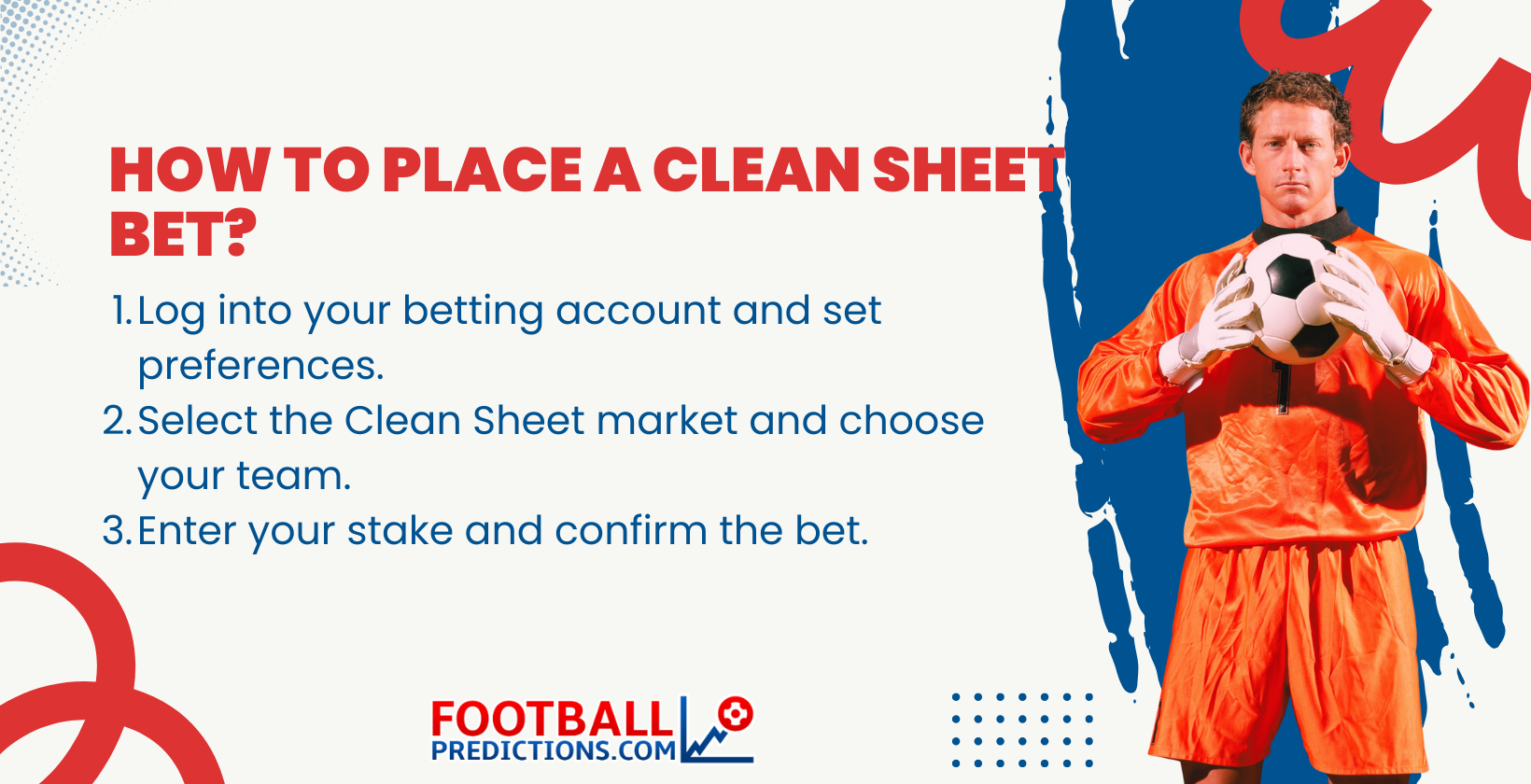
The 3 steps required to place a Clean Sheet bet are summarised below.
- Log into your betting account and set preferences. Use a reputable bookmaker that offers Clean Sheet markets, such as Bet365 or William Hill, and ensure your preferred odds format is displayed. Fractional odds like 3/1 show the profit relative to the stake. Checking multiple bookmakers before placing the bet helps secure the best available price.
- Select the Clean Sheet market and choose your team. Navigate to the chosen match, locate the “Clean Sheet – Yes/No” section, and pick the team you believe will prevent the opposition from scoring. Review statistics such as recent defensive form, goalkeeper availability, and the opponent’s scoring record to support your choice.
- Enter your stake and confirm the bet. Add your selection to the bet slip, select the “Yes” or “No” outcome in the Clean Sheet market, enter the amount you wish to wager, and double-check all details before confirming. Verify the team, market type, and settlement rules to ensure the bet aligns with your intended strategy.
What Are the Pros and Cons of Clean Sheet Betting?
Clean Sheet betting focuses on predicting whether a chosen team will prevent the opposition from scoring during the selected period of play. The two main advantages are that Clean Sheet betting often offers better odds than standard win markets and provides a focused defensive approach supported by clear data. The two main disadvantages of Clean Sheet Betting are that it is highly vulnerable to single events and demands extensive research to produce long-term value.
More information about the 2 key pros of Clean Sheet betting follows below.
- Often offers better odds than standard win markets. One of the main advantages of Clean Sheet betting is that the odds are frequently higher than simply backing the same team to win. Higher odds happen because this type of bet requires not only that the team performs well enough to avoid defeat but that it avoids conceding any goals as well. For example, a team priced at 3/2 in the Match Result market might be available at 11/10 in the Clean Sheet market against the same opponent, meaning the potential return is greater for the same stake.
- Provides a focused defensive approach supported by clear data. Another advantage of Clean Sheet betting is that it allows the bettor to concentrate entirely on defensive performance. Reliable statistics are available, such as the percentage of matches in which a team has kept a clean sheet, both at home and away. These figures make it easier to identify fixtures where defensive stability is likely, and many bookmakers offer this market both before the match and live, giving the bettor flexibility in timing the wager.
More information about the 2 key cons of Clean Sheet betting follows below.
- Highly vulnerable to single events. One significant drawback of Clean Sheet betting is its sensitivity to just one mistake or unpredictable incident. A deflected shot, a penalty, or even an own goal is enough to lose the bet, no matter how strong the defensive setup has been for the rest of the match. This fragility means that a single moment is able to turn a well-researched selection into a losing ticket.
- Requires extensive research to produce long-term value. Another drawback of Clean Sheet betting is the amount of detailed analysis needed to make informed selections. Successful betting in this market requires reviewing a team’s recent defensive record, the availability of key defenders and the goalkeeper, the attacking quality of the opponent, and the match context. Consistently finding selections with a positive expected return demands accurate interpretation of this data over a long period. The difficulty lies in maintaining an edge once bookmakers adjust their prices to reflect a team’s defensive strength, which often reduces profitability over time.
What Are the Best Teams for Clean Sheet Betting?
The best teams for Clean Sheet betting are identified by analysing the percentage of matches in which they concede zero goals, based on footballpredictions.com’s own internal data. To ensure reliability, each team must have played at least seven league matches before being included in the ranking. According to our data, the three best-performing teams for Clean Sheet betting are Riga W (Latvia), Aktobe (Kazakhstan), and Harju Jalgpallikool U21 (Estonia).
More information about the 3 best teams for Clean Sheet betting follows below.
- Riga W (Latvia) – 14 clean sheets in 15 matches (93%). Riga W are one of the leading women’s teams in Latvia’s top division. Known for dominating possession and controlling matches from start to finish, they have conceded in only one league match this season. Their 93% clean sheet rate reflects both tactical discipline and a goalkeeper who consistently shuts down threats.
- Aktobe (Kazakhstan) – 15 clean sheets in 17 matches (88%). Aktobe compete in Kazakhstan’s Premier League and are among the most defensively solid sides in the competition. Their strong backline and organised midfield play a key role in frustrating opposing forwards, leading to clean sheets in nearly nine out of ten league fixtures.
- Harju Jalgpallikool U21 (Estonia) – 7 clean sheets in 8 matches (88%). Harju Jalgpallikool U21 represent the youth development side of Harju JK in Estonia. Despite their status as a U21 team, they have shown remarkable defensive stability, conceding in just one league match this season. Their ability to maintain such form makes them an interesting choice in Clean Sheet betting markets.
How to Build a Clean Sheet Betting Strategy
Approaching Clean Sheet betting with a strategy increases the likelihood of finding value and reduces the risk of relying purely on instinct. Since this market depends on a team’s ability to avoid conceding, combining statistical analysis with match context offers a stronger foundation for making selections. The three most effective strategies for Clean Sheet betting are focusing on teams with exceptional defensive form, targeting matches with low-scoring opponents, and assessing match situations where defensive setups are more likely to succeed.
More information about the 3 best strategies for Clean Sheet betting follows below.
- Focus on teams with proven defensive consistency. Selecting sides with a high percentage of recent clean sheets is one of the most reliable approaches in the Clean Sheet market. League statistics such as shutout percentages highlight teams that regularly prevent goals. For example, sides like Riga W or Aktobe, which appear near the top of clean sheet tables, deliver consistent results due to disciplined defensive systems and strong goalkeeper performances.
- Target matches where the opponent struggles to score. Choosing fixtures where the attacking side has a poor scoring record increases the probability of a clean sheet. Reviewing metrics such as goals per game, shot conversion rate, and recent form helps identify opponents unlikely to break down a solid defence. This Clean Sheet betting approach works well when combined with knowledge of injuries or suspensions affecting the attacking team’s main goal threats.
- Select fixtures with tactical or situational incentives for defensive play. Certain match contexts encourage teams to prioritise defence, such as knockout ties, title-deciding clashes, or games against direct rivals. In these situations, teams often adopt conservative tactics to avoid conceding, especially when a draw or narrow win serves their objectives. Analysing fixture importance, manager tendencies, and past head-to-head results helps find games where a clean sheet outcome aligns with the team’s strategy.
Should You Combine Clean Sheet Bets With Other Markets?
Yes, combining Clean Sheet betting with certain markets improves value while keeping the selection focused. The best results come from pairings that complement the defensive nature of the clean sheet with either match outcome or goal-scoring potential for the opposing side.
More information about the 2 best combinations for Clean Sheet betting follows below.
- Clean Sheet Betting + Match Result. Combining Clean Sheet betting with the Match Result market creates a “Win to Nil” outcome, where the selected team wins the match without conceding a goal. This combination delivers higher odds than backing the win alone and rewards teams known for dominating both offensively and defensively.
- Clean Sheet Betting + Over 1.5 (for the other team). This pairing works when the opposing side is a strong favourite expected to control the match and create multiple scoring opportunities. The clean sheet applies to that favourite, while the Over 1.5 Goals market reflects their offensive strength, producing a combined selection that benefits from both defensive reliability and attacking firepower.
What’s the Difference Between a Clean Sheet Bet and an Under 0.5 Goals Bet?
The difference between a Clean Sheet bet and an Under 0.5 Goals bet lies in the scope and calculation of each market. While Clean Sheet betting focuses on whether a specific team avoids conceding a goal, Under 0.5 Goals betting concerns the total number of goals in the match being zero, regardless of which team is defending.
In Clean Sheet betting, the wager wins when the selected team finishes the match without conceding, even if the scoreline is 1–0, 2–0, or higher in their favour. Under 0.5 Goals betting only wins when the match ends 0–0, which means no goals are scored by either team. Although both markets overlap when the final score is 0–0, bookmakers calculate odds differently. Under 0.5 Goals is part of a wider set of goal line markets, while Clean Sheet betting offers only two outcomes (Yes or No) and applies to a single team rather than the entire match.
When Are Clean Sheet Betting Tips Updated?
Clean Sheet betting tips are generally updated 24 to 48 hours before kick-off. This timing allows analysts to incorporate confirmed team news, goalkeeper selections, and tactical adjustments that influence defensive performance, ensuring the advice reflects the most accurate and up-to-date information.
Should You Combine Clean Sheet Bets With Other Markets?
Yes, combining Clean Sheet betting with certain markets improves value while keeping the selection focused. The best results come from pairings that complement the defensive nature of the clean sheet with either match outcome or goal-scoring potential for the opposing side.
More information about the 2 best combinations for Clean Sheet betting follows below.
- Clean Sheet Betting + Match Result. Combining Clean Sheet betting with the Match Result market creates a “Win to Nil” outcome, where the selected team wins the match without conceding a goal. This combination delivers higher odds than backing the win alone and rewards teams known for dominating both offensively and defensively.
- Clean Sheet Betting + Over 1.5 (for the other team). This pairing works when the opposing side is a strong favourite expected to control the match and create multiple scoring opportunities. The clean sheet applies to that favourite, while the Over 1.5 Goals market reflects their offensive strength, producing a combined selection that benefits from both defensive reliability and attacking firepower.
What’s the Difference Between a Clean Sheet Bet and an Under 0.5 Goals Bet?
The difference between a Clean Sheet bet and an Under 0.5 Goals bet lies in the scope and calculation of each market. While Clean Sheet betting focuses on whether a specific team avoids conceding a goal, Under 0.5 Goals betting concerns the total number of goals in the match being zero, regardless of which team is defending.
In Clean Sheet betting, the wager wins when the selected team finishes the match without conceding, even if the scoreline is 1–0, 2–0, or higher in their favour. Under 0.5 Goals betting only wins when the match ends 0–0, which means no goals are scored by either team. Although both markets overlap when the final score is 0–0, bookmakers calculate odds differently. Under 0.5 Goals is part of a wider set of goal line markets, while Clean Sheet betting offers only two outcomes (Yes or No) and applies to a single team rather than the entire match.
When Are Clean Sheet Betting Tips Updated?
Clean Sheet betting tips are generally updated 24 to 48 hours before kick-off. This timing allows analysts to incorporate confirmed team news, goalkeeper selections, and tactical adjustments that influence defensive performance, ensuring the advice reflects the most accurate and up-to-date information.
When to Avoid Clean Sheet Bets?
One situation where Clean Sheet betting should be avoided is in matches involving two high-scoring teams with strong attacking records. In these fixtures, even defensively solid sides face a higher risk of conceding, and the odds rarely justify the increased uncertainty.
Another scenario to avoid Clean Sheet betting is during periods of heavy squad rotation, such as before or after important cup matches. When key defenders or the first-choice goalkeeper are rested, defensive organisation often suffers, raising the likelihood of conceding and weakening the reliability of the Clean Sheet bet.