
Half Time/Full Time Betting: Guide and Today’s Tips

| Match | Prediction Score | HT Tip | FT Tip | Odds | Probability |
|---|---|---|---|---|---|
 Elversberg Elversberg Armenia Bielefeld21/03/2026, 12:00 Armenia Bielefeld21/03/2026, 12:00 | 2-1 | Elversberg to Win | Elversberg to Win | 210 | 32% |
 Nurnberg Nurnberg Kaiserslautern21/03/2026, 12:00 Kaiserslautern21/03/2026, 12:00 | 2-1 | Nurnberg to Win | Nurnberg to Win | 240 | 29% |
 Paderborn Paderborn Dynamo Dresden21/03/2026, 12:00 Dynamo Dresden21/03/2026, 12:00 | 2-1 | Paderborn to Win | Paderborn to Win | 187 | 35% |
 Brighton Brighton Liverpool21/03/2026, 12:30 Liverpool21/03/2026, 12:30 | 1-2 | Liverpool to Win | Liverpool to Win | 260 | 28% |
 Blackburn Rovers Blackburn Rovers Middlesbrough21/03/2026, 12:30 Middlesbrough21/03/2026, 12:30 | 0-1 | Middlesbrough to Win | Middlesbrough to Win | 187 | 35% |
 Derby Derby Birmingham City21/03/2026, 12:30 Birmingham City21/03/2026, 12:30 | 1-1 | X (Draw) | X (Draw) | 400 | 20% |
 Ipswich Ipswich Millwall21/03/2026, 12:30 Millwall21/03/2026, 12:30 | 2-1 | Ipswich to Win | Ipswich to Win | 162 | 38% |
 Cardiff Cardiff Blackpool21/03/2026, 12:30 Blackpool21/03/2026, 12:30 | 3-0 | Cardiff to Win | Cardiff to Win | 100 | 50% |
 Luton Luton Stockport County21/03/2026, 12:30 Stockport County21/03/2026, 12:30 | 2-1 | Luton to Win | Luton to Win | 333 | 23% |
 Cambridge United Cambridge United Salford21/03/2026, 12:30 Salford21/03/2026, 12:30 | 2-1 | Cambridge Utd to Win | Cambridge Utd to Win | 210 | 32% |
 Leganes Leganes Ceuta21/03/2026, 13:00 Ceuta21/03/2026, 13:00 | 2-1 | Leganes to Win | Leganes to Win | 200 | 33% |
 Elche Elche Mallorca21/03/2026, 13:00 Mallorca21/03/2026, 13:00 | 1-1 | X (Draw) | X (Draw) | 450 | 18% |
 Cesena Cesena Catanzaro21/03/2026, 14:00 Catanzaro21/03/2026, 14:00 | 0-2 | Catanzaro to Win | Catanzaro to Win | 333 | 23% |
 Juve Stabia Juve Stabia Spezia21/03/2026, 14:00 Spezia21/03/2026, 14:00 | 1-1 | X (Draw) | X (Draw) | 350 | 22% |
 Padova Padova Palermo21/03/2026, 14:00 Palermo21/03/2026, 14:00 | 1-2 | Palermo to Win | Palermo to Win | 162 | 38% |
 Parma Parma Cremonese21/03/2026, 14:00 Cremonese21/03/2026, 14:00 | 1-0 | Parma to Win | Parma to Win | 275 | 27% |
 Bayern Munich Bayern Munich Union Berlin21/03/2026, 14:30 Union Berlin21/03/2026, 14:30 | 3-0 | Bayern Munich to Win | Bayern Munich to Win | -200 | 67% |
 Heidenheim Heidenheim Bayer Leverkusen21/03/2026, 14:30 Bayer Leverkusen21/03/2026, 14:30 | 1-2 | Bayer Leverkusen to Win | Bayer Leverkusen to Win | 130 | 43% |
 Wolfsburg Wolfsburg Werder Bremen21/03/2026, 14:30 Werder Bremen21/03/2026, 14:30 | 2-2 | X (Draw) | X (Draw) | 500 | 17% |
 Fulham Fulham Burnley21/03/2026, 15:00 Burnley21/03/2026, 15:00 | 2-1 | Fulham to Win | Fulham to Win | 130 | 43% |
 Bristol City Bristol City West Bromwich21/03/2026, 15:00 West Bromwich21/03/2026, 15:00 | 1-1 | X (Draw) | X (Draw) | 400 | 20% |
 Charlton Charlton Norwich21/03/2026, 15:00 Norwich21/03/2026, 15:00 | 0-1 | Norwich to Win | Norwich to Win | 275 | 27% |
 QPR QPR Portsmouth21/03/2026, 15:00 Portsmouth21/03/2026, 15:00 | 1-0 | QPR to Win | QPR to Win | 375 | 21% |
 Sheffield United Sheffield United Wrexham21/03/2026, 15:00 Wrexham21/03/2026, 15:00 | 3-2 | Sheff Utd to Win | Sheff Utd to Win | 210 | 32% |
 Southampton Southampton Oxford United21/03/2026, 15:00 Oxford United21/03/2026, 15:00 | 3-1 | Southampton to Win | Southampton to Win | 137 | 42% |
 Watford Watford Leicester21/03/2026, 15:00 Leicester21/03/2026, 15:00 | 3-0 | Watford to Win | Watford to Win | 210 | 32% |
 AFC Wimbledon AFC Wimbledon Peterborough21/03/2026, 15:00 Peterborough21/03/2026, 15:00 | 3-1 | AFC Wimbledon to Win | AFC Wimbledon to Win | 250 | 29% |
 Barnsley Barnsley Doncaster21/03/2026, 15:00 Doncaster21/03/2026, 15:00 | 2-1 | Barnsley to Win | Barnsley to Win | 275 | 27% |
 Burton Burton Bradford21/03/2026, 15:00 Bradford21/03/2026, 15:00 | 1-1 | X (Draw) | X (Draw) | 375 | 21% |
 Leyton Orient Leyton Orient Wycombe21/03/2026, 15:00 Wycombe21/03/2026, 15:00 | 2-2 | X (Draw) | X (Draw) | 400 | 20% |
 Lincoln Lincoln Rotherham21/03/2026, 15:00 Rotherham21/03/2026, 15:00 | 2-0 | Lincoln City to Win | Lincoln City to Win | -111 | 52% |
 Mansfield Mansfield Northampton21/03/2026, 15:00 Northampton21/03/2026, 15:00 | 1-0 | Mansfield to Win | Mansfield to Win | 162 | 38% |
 Plymouth Plymouth Huddersfield21/03/2026, 15:00 Huddersfield21/03/2026, 15:00 | 2-1 | Plymouth to Win | Plymouth to Win | 260 | 28% |
 Port Vale Port Vale Bolton21/03/2026, 15:00 Bolton21/03/2026, 15:00 | 0-2 | Bolton to Win | Bolton to Win | 130 | 43% |
 Stevenage Stevenage Reading21/03/2026, 15:00 Reading21/03/2026, 15:00 | 1-1 | X (Draw) | X (Draw) | 300 | 25% |
 Wigan Wigan Exeter21/03/2026, 15:00 Exeter21/03/2026, 15:00 | 1-0 | Wigan to Win | Wigan to Win | 225 | 31% |
 Accrington Accrington Chesterfield21/03/2026, 15:00 Chesterfield21/03/2026, 15:00 | 1-2 | Chesterfield to Win | Chesterfield to Win | 200 | 33% |
 Bromley Bromley Colchester21/03/2026, 15:00 Colchester21/03/2026, 15:00 | 1-0 | Bromley to Win | Bromley to Win | 275 | 27% |
 Fleetwood Fleetwood Crawley21/03/2026, 15:00 Crawley21/03/2026, 15:00 | 1-0 | Fleetwood Town to Win | Fleetwood Town to Win | 200 | 33% |
 Gillingham Gillingham Bristol Rovers21/03/2026, 15:00 Bristol Rovers21/03/2026, 15:00 | 0-1 | Bristol Rovers to Win | Bristol Rovers to Win | 333 | 23% |
 Grimsby Grimsby Barrow21/03/2026, 15:00 Barrow21/03/2026, 15:00 | 2-0 | Grimsby to Win | Grimsby to Win | 150 | 40% |
 Notts County Notts County Cheltenham21/03/2026, 15:00 Cheltenham21/03/2026, 15:00 | 3-1 | Notts County to Win | Notts County to Win | 137 | 42% |
 Oldham Oldham Harrogate21/03/2026, 15:00 Harrogate21/03/2026, 15:00 | 2-1 | Oldham to Win | Oldham to Win | 150 | 40% |
 Shrewsbury Shrewsbury Crewe21/03/2026, 15:00 Crewe21/03/2026, 15:00 | 1-1 | X (Draw) | X (Draw) | 400 | 20% |
 Tranmere Tranmere Swindon21/03/2026, 15:00 Swindon21/03/2026, 15:00 | 0-2 | Swindon to Win | Swindon to Win | 210 | 32% |
 Walsall Walsall Newport County21/03/2026, 15:00 Newport County21/03/2026, 15:00 | 1-1 | X (Draw) | X (Draw) | 400 | 20% |
 Falkirk Falkirk St Mirren21/03/2026, 15:00 St Mirren21/03/2026, 15:00 | 2-0 | Falkirk to Win | Falkirk to Win | 175 | 36% |
 Hearts Hearts Dundee FC21/03/2026, 15:00 Dundee FC21/03/2026, 15:00 | 2-0 | Hearts to Win | Hearts to Win | 100 | 50% |
 Kilmarnock Kilmarnock Livingston21/03/2026, 15:00 Livingston21/03/2026, 15:00 | 2-0 | Kilmarnock to Win | Kilmarnock to Win | 187 | 35% |
 Motherwell Motherwell Hibernian21/03/2026, 15:00 Hibernian21/03/2026, 15:00 | 2-1 | Motherwell to Win | Motherwell to Win | 210 | 32% |
 Andorra FC Andorra FC Eibar21/03/2026, 15:15 Eibar21/03/2026, 15:15 | 1-1 | X (Draw) | X (Draw) | 333 | 23% |
 Racing Santander Racing Santander Albacete21/03/2026, 15:15 Albacete21/03/2026, 15:15 | 2-1 | Racing Santander to Win | Racing Santander to Win | 162 | 38% |
 Espanyol Espanyol Getafe21/03/2026, 15:15 Getafe21/03/2026, 15:15 | 1-1 | X (Draw) | X (Draw) | 275 | 27% |
 Famalicao Famalicao Nacional21/03/2026, 15:30 Nacional21/03/2026, 15:30 | 2-1 | Famalicao to Win | Famalicao to Win | 140 | 42% |
 Moreirense Moreirense Arouca21/03/2026, 15:30 Arouca21/03/2026, 15:30 | 1-1 | X (Draw) | X (Draw) | 375 | 21% |
 Toulouse Toulouse Lorient21/03/2026, 16:00 Lorient21/03/2026, 16:00 | 2-2 | X (Draw) | X (Draw) | 400 | 20% |
 Monza Monza Venezia21/03/2026, 16:15 Venezia21/03/2026, 16:15 | 1-1 | X (Draw) | X (Draw) | 450 | 18% |
 Milan Milan Torino21/03/2026, 17:00 Torino21/03/2026, 17:00 | 1-0 | AC Milan to Win | AC Milan to Win | -105 | 51% |
 Toronto FC Toronto FC Columbus Crew21/03/2026, 17:00 Columbus Crew21/03/2026, 17:00 | 1-1 | X (Draw) | X (Draw) | 450 | 18% |
 Swansea Swansea Coventry21/03/2026, 17:15 Coventry21/03/2026, 17:15 | 0-1 | Coventry to Win | Coventry to Win | 260 | 28% |
 Everton Everton Chelsea21/03/2026, 17:30 Chelsea21/03/2026, 17:30 | 0-2 | Chelsea to Win | Chelsea to Win | 275 | 27% |
 Cadiz Cadiz Malaga21/03/2026, 17:30 Malaga21/03/2026, 17:30 | 0-1 | Malaga to Win | Malaga to Win | 275 | 27% |
 Levante Levante Oviedo21/03/2026, 17:30 Oviedo21/03/2026, 17:30 | 1-1 | X (Draw) | X (Draw) | 375 | 21% |
 Osasuna Osasuna Girona21/03/2026, 17:30 Girona21/03/2026, 17:30 | 1-1 | X (Draw) | X (Draw) | 450 | 18% |
 Borussia Dortmund Borussia Dortmund Hamburg21/03/2026, 17:30 Hamburg21/03/2026, 17:30 | 3-1 | Borussia Dortmund to Win | Borussia Dortmund to Win | 105 | 49% |
 Sparta Rotterdam Sparta Rotterdam Volendam21/03/2026, 17:45 Volendam21/03/2026, 17:45 | 3-1 | Sparta Rotterdam to Win | Sparta Rotterdam to Win | 110 | 48% |
 Rangers Rangers Aberdeen21/03/2026, 17:45 Aberdeen21/03/2026, 17:45 | 3-0 | Rangers to Win | Rangers to Win | -125 | 56% |
 Auxerre Auxerre Brest21/03/2026, 18:00 Brest21/03/2026, 18:00 | 1-1 | X (Draw) | X (Draw) | 350 | 22% |
 Benfica Benfica Guimaraes21/03/2026, 18:00 Guimaraes21/03/2026, 18:00 | 2-1 | Benfica to Win | Benfica to Win | -138 | 58% |
 Santa Clara Santa Clara Gil Vicente21/03/2026, 18:00 Gil Vicente21/03/2026, 18:00 | 2-2 | X (Draw) | X (Draw) | 300 | 25% |
 Modena Modena Mantova21/03/2026, 18:30 Mantova21/03/2026, 18:30 | 1-1 | X (Draw) | X (Draw) | 450 | 18% |
 Darmstadt Darmstadt Schalke21/03/2026, 19:30 Schalke21/03/2026, 19:30 | 2-2 | X (Draw) | X (Draw) | 450 | 18% |
 Juventus Juventus Sassuolo21/03/2026, 19:45 Sassuolo21/03/2026, 19:45 | 3-1 | Juventus to Win | Juventus to Win | -120 | 55% |
 Leeds United Leeds United Brentford21/03/2026, 20:00 Brentford21/03/2026, 20:00 | 1-1 | X (Draw) | X (Draw) | 450 | 18% |
 Sevilla Sevilla Valencia21/03/2026, 20:00 Valencia21/03/2026, 20:00 | 1-1 | X (Draw) | X (Draw) | 350 | 22% |
 Nice Nice PSG21/03/2026, 20:00 PSG21/03/2026, 20:00 | 1-2 | PSG to Win | PSG to Win | 110 | 48% |
 Tondela Tondela AFS21/03/2026, 20:30 AFS21/03/2026, 20:30 | 3-1 | Tondela to Win | Tondela to Win | 200 | 33% |
 Philadelphia Union Philadelphia Union Chicago Fire21/03/2026, 20:30 Chicago Fire21/03/2026, 20:30 | 2-2 | X (Draw) | X (Draw) | 450 | 18% |
 Nashville SC Nashville SC Orlando City21/03/2026, 22:15 Orlando City21/03/2026, 22:15 | 2-0 | Nashville SC to Win | Nashville SC to Win | 110 | 48% |
 Atlanta United Atlanta United DC United21/03/2026, 23:30 DC United21/03/2026, 23:30 | 2-2 | X (Draw) | X (Draw) | 450 | 18% |
 Charlotte Charlotte New York Red Bulls21/03/2026, 23:30 New York Red Bulls21/03/2026, 23:30 | 1-1 | X (Draw) | X (Draw) | 500 | 17% |
Half Time / Full Time, sometimes called HT/FT, is a type of Match Result football wager where the bettor predicts the leading team at both half-time and full-time in a single match. The HT/FT market is settled only when both stages match the exact prediction. Possible outcomes combine any of the three half-time results (home, draw, away) with any of the three full-time results, producing nine distinct options. This format offers higher odds than standard Match Result betting because it requires accuracy at two separate points in the same game, making match flow analysis essential.
The steps required to place a Half Time / Full Time wager involve signing in to a licensed sportsbook, selecting the desired fixture and HT/FT combination, and confirming the stake. Bettors choose from options such as Home/Home, Draw/Home, Away/Draw, or Draw/Away, each representing a different sequence of results between the two stages.
A successful Half Time / Full Time betting strategy uses team performance trends, statistical data, and situational factors to target value combinations. Selecting Home/Home works best for dominant sides with strong first-half scoring records, while Draw/Home is suited to teams that start cautiously but often overpower opponents in the second half. Incorporating metrics such as first-half goal averages and late goal frequency increases prediction accuracy.
The advantages of Half Time / Full Time betting include the potential for enhanced value on strong favourites or quick starters, and the flexibility to forecast specific match flows rather than only the final score. Some of the disadvantages of Half Time / Full Time bets are the elevated risk from needing two correct outcomes and the higher bookmaker margins compared to core markets like Match Result or Asian Handicap, which can reduce long-term profitability.
The best combinations between Half Time / Full Time and other markets include pairing it with First Goalscorer when the likely leaders are strongly linked to a key striker opening the scoring, or with Both Teams to Score when the expected winner is prone to conceding. These combinations allow for more detailed predictions and increased odds while maintaining a coherent match scenario.
What Is a Half Time / Full Time Bet?
Half Time / Full Time (HT/FT) is a football betting market where the bettor predicts which team will be leading at the end of the first half and which team will go on to win the full match. An HT/FT bet requires two correct calls within the same game: who will be ahead after 45 minutes and who will be ahead at the final whistle.
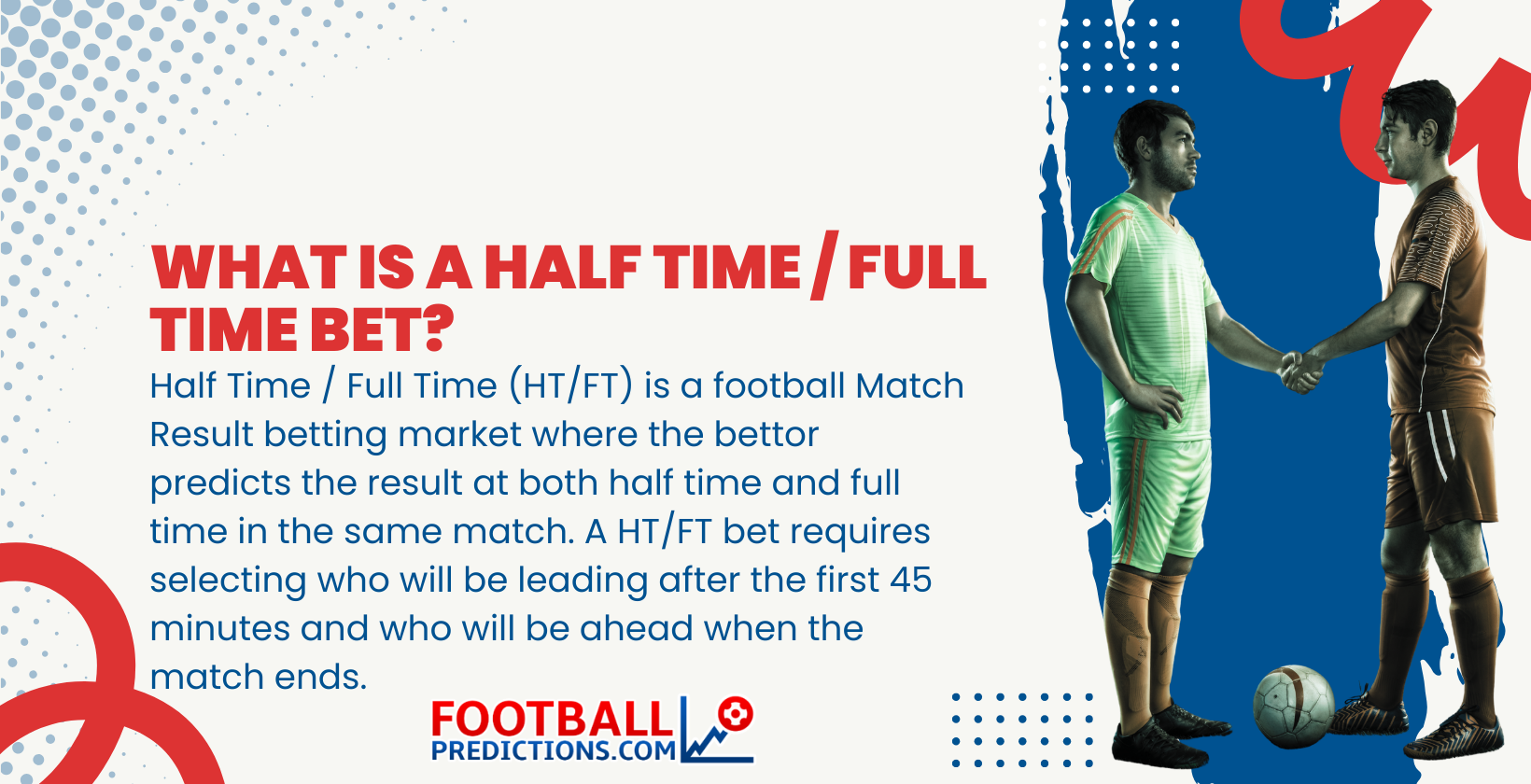
Possible outcomes include the same team winning at both stages, one team leading at half time and the other turning it around by full time, or both stages ending level. This format offers higher odds than standard Match Result or Correct Score betting because it demands two correct predictions within one game.
A clear example that illustrates how the Half Time / Full Time market works involves a scenario from a Premier League fixture between Manchester City and Tottenham Hotspur. For instance, a selection of Manchester City/Manchester City means Manchester City must be ahead at the break and still win at the end of 90 minutes. Choosing Draw/Manchester City means the teams finish the first half level before Manchester City takes the lead and wins by full time. Correctly predicting both stages produces a payout based on combined odds that are typically much higher than for a simple match winner.
How Does Half Time / Full Time Betting Work?
Half Time / Full Time betting works by dividing the match into two settled stages, each with its own predicted result. The bettor chooses one outcome for the first half and another for the full 90 minutes plus injury time. The HT/FT bet is successful only when both stages match the prediction exactly. Bookmakers price each possible combination based on the likelihood of that sequence occurring, which leads to a wide range of odds from short prices on dominant favourites to long odds for unlikely comebacks.
The Half Time / Full Time market differs from regular Match Result betting because it requires accuracy at two separate points rather than only at the end of the match. In football, the result at half time often shapes the final score, so this format demands analysis of teams’ scoring patterns, tactical approaches in each half, and historical performance when leading or trailing at the break.
There are nine standard outcomes available in the Half Time / Full Time market – Home/Home (1/1), Draw/Home (X/1), Away/Home (2/1), Home/Draw (1/X), Draw/Draw (X/X), Away/Draw (2/X), Home/Away (1/2), Draw/Away (X/2), and Away/Away (2/2). The first part of each option refers to the half-time situation, while the second refers to the full-time result. For example, a Draw/Home (X/1) means the teams are level at the break, but the home side finishes the match ahead.
The nine standard outcomes in Half Time / Full Time betting are shown in the table below:
| Outcome | Half Time | Full Time | Example meaning |
|---|---|---|---|
| Home/Home (1/1) | Home team ahead | Home team ahead | The home side leads at both stages |
| Draw/Home (X/1) | Level | Home team ahead | Teams tied at half time, home team wins the match |
| Away/Home (2/1) | Away team ahead | Home team ahead | Away side leads at half, home side comes back to win |
| Home/Draw (1/X) | Home team ahead | Level | Home side leads at half, but the match finishes tied |
| Draw/Draw (X/X) | Level | Level | No side leads at either stage |
| Away/Draw (2/X) | Away team ahead | Level | Away side leads at half, match ends in a draw |
| Home/Away (1/2) | Home team ahead | Away team ahead | Home side leads at half, away side wins in the end |
| Draw/Away (X/2) | Level | Away team ahead | Teams tied at half time, away side wins at full time |
| Away/Away (2/2) | Away team ahead | Away team ahead | Away side leads at both stages |
How to Place a Half Time / Full Time Bet
Placing a Half Time / Full Time wager is a three-step process. These steps involve signing in to your sportsbook account, selecting the match and the exact Half Time / Full Time outcome, and confirming the wager with a stake.
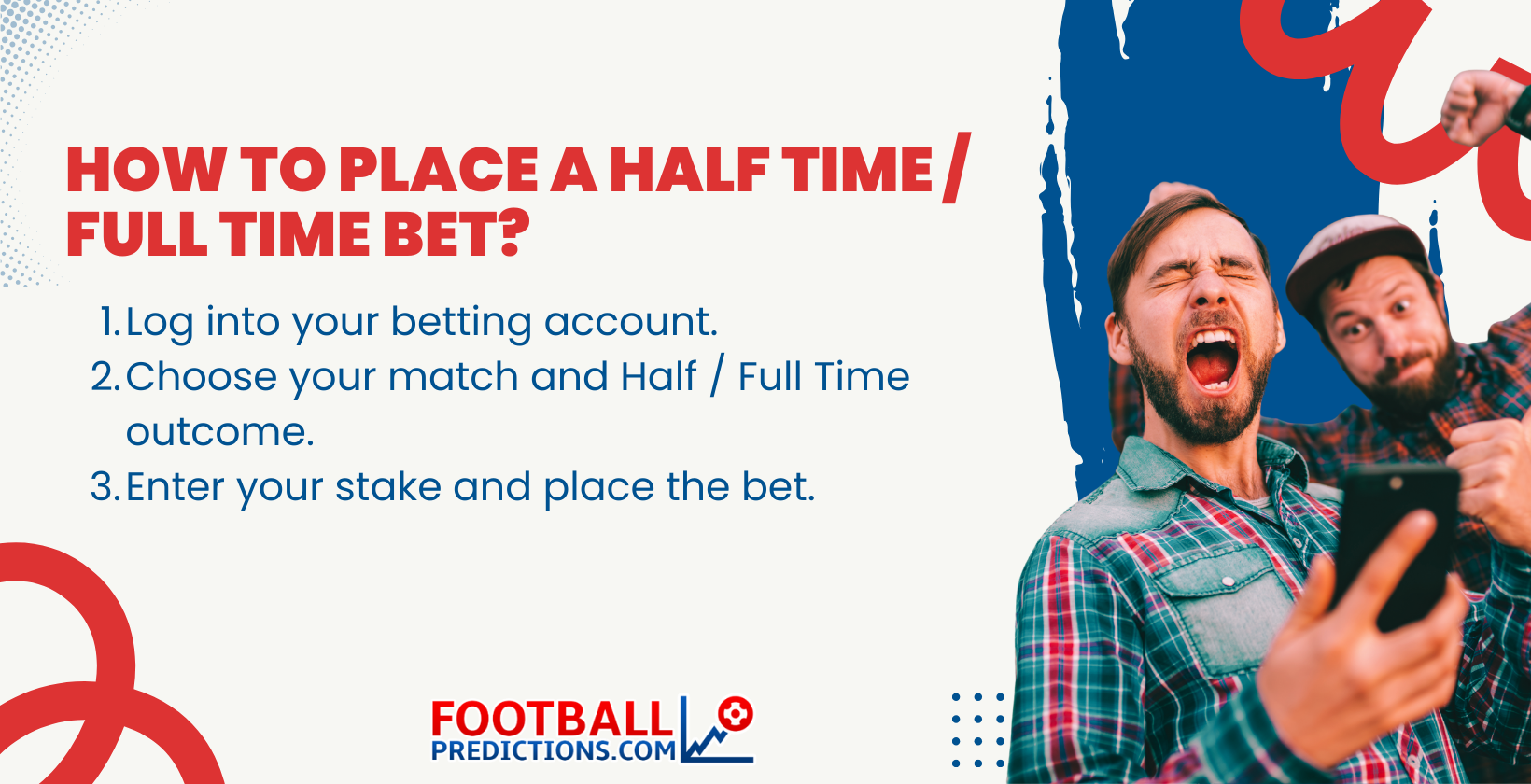
More information about the 3 steps required to place a Half Time / Full Time bet is given below.
- Log into your betting account. Use a licensed sportsbook that lists Half Time / Full Time markets, for example Bet365 or William Hill, and set your preferred odds format so every quote is clear. For example, fractional odds such as 4/1 mean £10 returns £50 in total. Comparing prices across two or three books helps secure a stronger number before you commit.
- Choose your match and Half Time / Full Time outcome. Open the fixture and locate the Half Time / Full Time market. The nine standard options are Home/Home (1/1), Draw/Home (X/1), Away/Home (2/1), Home/Draw (1/X), Draw/Draw (X/X), Away/Draw (2/X), Home/Away (1/2), Draw/Away (X/2), and Away/Away (2/2). The first part refers to the result at 45 minutes, the second to the final score after 90 minutes plus stoppage time. Extra time and penalties never count. For example, Draw/Home means level at the break and the home team ahead at full time, while Home/Home means the home side leads at half time and still leads at full time.
- Enter your stake and place the bet. Add the selection to the bet slip, type your stake, and check every field – teams, the two outcomes, the odds, and settlement rules. Bankroll planning matters because the Half Time / Full Time model relies on an all-or-nothing basis. Example: £10 on Draw/Home at 4/1 returns £50 when the match reaches half time at 0–0 and finishes 2–1 to the home side. A single miss on either checkpoint turns the ticket into a loss.
What Are the Pros and Cons of Half Time / Full Time betting?
Half Time / Full Time betting requires predicting the result at the interval and the final result. The two key advantages of Half Time / Full Time are enhanced value on strong favourites or quick starters and the flexibility to model specific match flow across both halves. The two key disadvantages are elevated risk from the two-condition settlement and typically higher bookmaker margins than core markets such as Match Result and Asian Handicap.
More information about the 2 key pros of Half Time / Full Time betting is given below.
- Enhanced value on strong favourites or quick starters. Half Time / Full Time betting rewards predictions on both the half-time and full-time scoreline, which makes it possible to find bigger odds than in simpler markets. This extra condition offers a significant boost when backing strong favourites or teams known for scoring early. In comparison, the Match Result market (often written as 1X2) only requires selecting the final outcome – home win, draw, or away win. Odds in 1X2 for heavy favourites are often very short, such as 2/5, meaning a £10 stake returns just £14 in total. By choosing the Half Time / Full Time Home/Home option for the same team, the price might rise to 19/20 if statistics show they regularly lead at the break and maintain control until the final whistle.
- Flexibility to model specific match scripts. Half Time / Full Time betting offers nine possible outcomes, formed by combining the three half-time results (Home, Draw, Away) with the three full-time results. This variety allows punters to forecast not only the winner but how the game unfolds. For instance, Draw/Home suits sides that start slowly yet finish strongly, while Home/Draw fits teams that often protect leads and drop late points. Analysing club tendencies by half, such as first-half goal timings or substitutions that change momentum, turns HT/FT into a precise and informed betting tool.
More information about the 2 key cons of Half Time / Full Time betting is given below.
- Elevated risk from two conditions. Settlement requires both parts to land. A clear example is Draw/Home losing when the home team scores early and reaches half time ahead, even though the same team still wins the match. Another classic miss occurs on Home/Home when a late equaliser turns the final result into a draw after a correct half-time lead. Having two separate checkpoints means twice the chance for something to go wrong, making near-misses more common than in single-stage bets.
- Higher bookmaker margins than core markets. Bookmakers usually price HT/FT betting with a larger built-in edge than Match Result or Asian Handicap. Match Result offers three outcomes with broad liquidity, while Asian Handicap is a two-way market that removes the draw by applying goal handicaps. When it comes to Half Time / Full Time, the odds are slightly less favourable for the bettor because the bookmaker takes a larger percentage as profit. The lower value is due to the nine possible outcomes and the correlation between halves, which makes pricing more complex and riskier for the bookmaker. As a result, finding consistently profitable opportunities in HT/FT markets is harder than in lower-margin markets.
How to Build a Half Time / Full Time Betting Strategy
The best way to build a Half Time / Full Time (HT/FT) football betting strategy is by following a structured process that moves from identifying reliable starting points to refining those ideas with data and then looking for value in the market. Success in this bet type requires accuracy at two different points of a match, so the approach has to be both realistic and evidence-based. The most effective sequence begins with focusing on dominant early performers, then targeting comeback scenarios, and finally using statistical trends to find value.
First, when building your HT/FT strategy it’s helpful to focus on dominant teams with strong early performance. The safest starting point is to identify clubs that regularly lead matches by half time and carry that advantage through to the final whistle. Choosing a Home/Home or Away/Away outcome in these cases offers more attractive odds than a simple Match Result bet. Historical data on early scoring patterns, average goal timings, and possession control helps confirm whether a team is suited to this type of prediction. For example, a side priced at 4/6 to win outright is often available at 19/20 for Home/Home if their track record shows consistent half-time leads that convert into full-time wins.
Next, target comeback scenarios where late strength pays off. Some football teams tend to start slowly but grow into matches thanks to tactical changes, substitutions, or superior fitness levels. For these sides, combinations like Draw/Home or Draw/Away can hold significant value. Analysing past fixtures often reveals sides that draw frequently at half time before turning matches around in the second half. Looking at records such as goals scored after the 60th minute, or patterns in home performances against mid-table rivals, gives a clearer picture of where comeback bets are worth backing.
Finally, use statistical trends to filter and identify value. Once you know whether you are targeting dominant starters or comeback teams, bring in wider league data to confirm your choices. Football trends such as high percentages of half-time draws, frequent late goals, or consistent home win rates provide context for refining HT/FT predictions. For instance, when league data shows a high rate of half-time draws, but a particular home side often breaks deadlocks late on, the Draw/Home outcome becomes more appealing. Adding factors like weather conditions, pitch quality, or tactical matchups ensures the final selection is supported by multiple layers of evidence rather than guesswork.
Should I Combine Half Time / Full Time With Other Markets?
Yes, combining Half Time / Full Time betting with other markets is a strong strategy because it allows bettors to increase odds while building a more detailed prediction of how the match will unfold. Two of the most effective combinations are pairing Half Time / Full Time with First Goalscorer or Both Teams to Score.
More information about the 2 best combinations of Half Time / Full Time bets with other markets is given below.
- Half Time / Full Time + First Goalscorer. This combination works well when the likely leaders at each stage are closely linked to a specific player’s ability to score first. For example, backing Home/Home alongside a striker as First Goalscorer suits matches where the home side typically scores early and that player has a strong record of opening the scoring. This pairing responds to a strategy focused on early dominance and a key player’s influence in setting the tone of the game.
- Half Time / Full Time + Both Teams to Score (BTTS). Pairing Half Time / Full Time with BTTS fits fixtures where the favoured team is expected to lead at the break and secure the win, but both sides are likely to score. For instance, selecting Away/Away with Both Teams to Score makes sense if the away side often takes early control yet concedes due to defensive gaps. This approach increases the return potential by linking a timed lead prediction with a proven scoring pattern from both teams.
What’s the Difference Between Half Time / Full Time and Regular Match Result Betting?
The main difference between Half Time / Full Time and Regular Match Result betting lies in the number of predictions required. While Half Time / Full Time demands correctly forecasting both the leader at half time and the winner at full time in a single wager, Match Result betting focuses only on who wins after 90 minutes plus injury time, without considering the mid-game score.
A further difference between Half Time / Full Time and Regular Match Result betting is in the level of complexity and risk. Half Time / Full Time involves greater difficulty because both stages must be accurate, which naturally produces longer odds. Regular Match Result is easier to predict since it only requires assessing the likely final score. Success with Half Time / Full Time requires deeper analysis, including how teams start matches, their ability to recover from losing positions, and the impact of tactical adjustments during the game.
What Are Half Time / Full Time Betting Predictions Based On?
Half Time / Full Time betting predictions are based on assessing how a match is likely to develop across both halves, which involves evaluating team form, attacking and defensive records by half, and head-to-head trends. For example, some sides score early due to aggressive starts, while others are known for strong finishes after tactical adjustments.
Another key element to make accurate Half Time / Full Time predictions is the use of match statistics. Metrics such as average first-half goals scored, late goal frequency, and substitution impact help identify patterns that influence half-time and full-time outcomes. For example, a team averaging 1.2 goals in the first half but only 0.4 in the second is a strong candidate for a Home/Draw scenario, where they lead at the break but lose momentum and fail to secure the win. These statistical insights, when combined with situational factors like injuries, fixture congestion, and tactical matchups, form the backbone of reliable Half Time / Full Time forecasting.
When Are Half Time / Full Time Betting Tips Updated?
Half Time / Full Time betting tips are usually updated 24 to 48 hours before kick-off, once confirmed line-ups, injury news, and any tactical changes are available. This timing ensures that football betting tips account for the most up-to-date information, including the presence or absence of key scorers or defenders who could influence the game’s momentum at different stages.
When to Avoid Half Time / Full Time Bets?
Half Time / Full Time bets are best avoided in matches where the expected winner often starts slowly or relies heavily on late goals. In these situations, predicting both the half-time and full-time leader becomes far less reliable, even if the favourite still wins the match.
Another situation where Half Time / Full Time wagers are less suitable occurs when unpredictable elements disrupt the natural flow of the game. These elements include derby matches with high emotional intensity, games played in extreme weather, or fixtures involving teams with erratic form. In such cases, the increased complexity of needing two correct predictions significantly raises the likelihood of losing the wager.