
18 Most Important Football Betting Rules

Betting rules are the terms bookmakers use to decide how football bets are settled. These rules cover scenarios such as match delays, player absence, and incomplete fixtures, helping ensure fair outcomes and consistent payouts.
Most bookmakers publish detailed betting rules that span dozens of scenarios. These include settlement based on regular time (usually 90 minutes plus stoppage), procedures for postponed or interrupted fixtures, how card and goalscorer markets function, and what happens when player participation conditions aren’t met.
Football betting rules provide bookmakers with a consistent framework for settling bets, and they help bettors understand how outcomes are determined when matches do not go as planned. For example, in the case of a match that is abandoned after the first half, your Half-Time Result bet is still settled, while your Match Result bet is voided. In goalscorer markets, a First Goalscorer bet is only valid if your player starts or comes on before the first valid goal is scored.
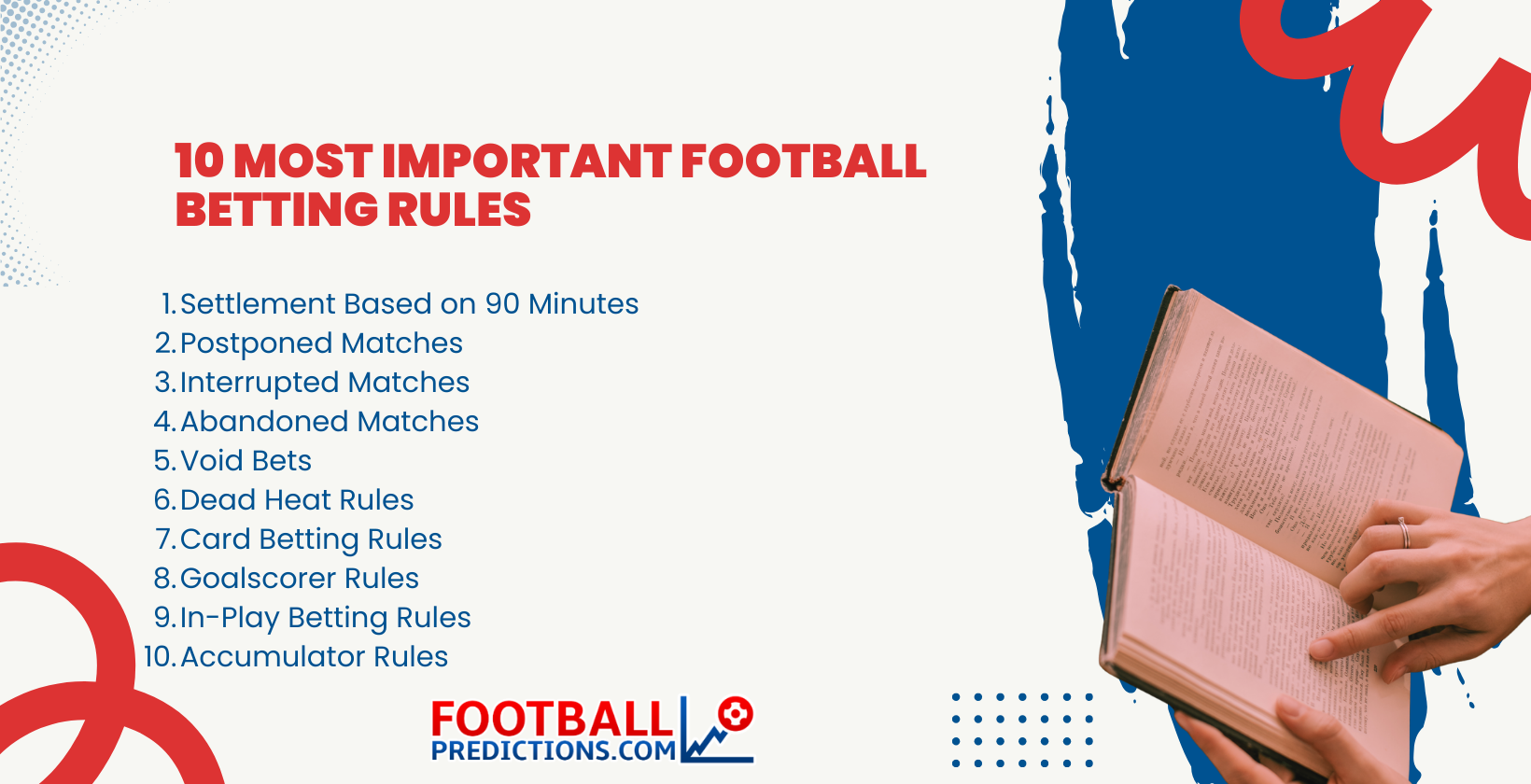
The 10 most important football betting rules are outlined below.
- Settlement Based on 90 Minutes. The 90-minute play rule states that most bets are settled based on the score at the end of regular time, including stoppage time, but not extra time or penalties.
- Postponed Matches. Postponement rules state that a match not played as scheduled is void unless rescheduled within the bookmaker’s allowed timeframe, usually 24 to 72 hours.
- Interrupted Matches. Rules for interrupted matches indicate that when a match is paused after kick-off, the bet remains valid only if the game resumes and finishes within the operator’s time window.
- Abandoned Matches. A match that starts but does not finish and is not resumed within the allowed timeframe is considered abandoned, voiding most bets unless the outcome was already decided.
- Void Bets. Void bets return the original stake to the bettor when a match is not played, not completed, or when key conditions like player participation are not met.
- Dead Heat Rules. Dead Heat rules state that when two or more outcomes tie in a market that expects one winner, the stake is divided equally and paid at full odds for each tied selection.
- Card Betting Rules. Card bets are settled based on cards shown during regular time, excluding those issued after the final whistle or to non-playing staff.
- Goalscorer Rules. Goalscorer rules state that the selected player must be on the pitch before the first valid goal is scored for the bet to stand, and the goal must be scored within 90 minutes plus stoppage time for the bet to be settled as a win.
- In-Play Betting Rules. In-play betting rules specify that bets follow the 90-minute settlement rule and are voided if the match is not completed on the same calendar day unless the outcome has already been settled.
- Accumulator Rules. Accumulator rules state that each leg is governed by its own settlement rule, and any voided leg is removed while the odds are recalculated based on the remaining selections.
The remaining 8 of the 18 most important football betting rules are about stat-based markets, maximum payout limits, 2Up promotions, own goal rules, player substitution and participation rules, extra time and penalties, cash out rules, and bet builders.
Table of Contents
1. Settlement Based on 90 Minutes
The “settlement based on 90 minutes” rule in football betting means that all bets are settled according to the result at the end of regular time, which includes the standard 90 minutes of play plus any injury or stoppage time added by the referee. The 90-minute rule excludes extra-time and penalty shootouts, even when those periods decide the final outcome of a match. This rule is commonly applied in both league fixtures and knockout tournaments to ensure clarity and consistency when determining the outcome of a bet.
90-minute play guidelines affect key markets such as Match Result, Correct Score, Over/Under Goals, and First/Last Goalscorer bets. For example, a Match Result bet ends in a draw if the score is level at 90 minutes, even if one team wins in extra time. Over/Under bets are settled based on goals scored within regular time, and scorers only count if the goals are made before the final whistle of stoppage time. By aligning the 90 minutes play rule across these markets, bookmakers reduce confusion, manage risk more effectively, and provide bettors with a clear understanding of when and how their bets are resolved.
A clear modern example of the 90-minute settlement rule occurred during the UEFA Euro 2020 Round of 16 match between Italy and Austria, played on 26 June 2021. The game finished 0–0 at the end of 90 minutes plus stoppage time, before Italy went on to win 2–1 in extra time. For betting purposes, all Match Result wagers were settled as a draw, because the score at the end of regular time determines settlement under the 90-minute rule. Meanwhile, Over 2.5 Goals bets were lost because no goals were scored within regular time, and First or Last Goalscorer bets were void or settled as losers, since both goals occurred in extra time and are excluded from 90-minute settlement markets.
2. Postponed Matches
In football betting, a postponed match refers to any fixture that fails to begin at the scheduled time and date due to factors like severe weather, health issues, or safety concerns. When a match is postponed, bets are typically voided unless the game is rescheduled and played within a specific timeframe set by the bookmaker, usually 24 to 72 hours. Rules for postponed matches ensure clarity and fairness, as they exclude situations where line-ups or match conditions change significantly between the original and the rescheduled date. The rule only applies to matches that never start. Fixtures interrupted mid-play are governed by different betting rules.
Postponement rules impact several major betting markets, including Match Result, Correct Score, Over/Under Goals, and To Qualify. In most cases, bets on a postponed fixture are voided unless the match is played within the bookmaker’s defined window. In accumulators, the affected leg is usually removed, and the odds are recalculated based on the remaining selections. By applying consistent postponement policies, bookmakers manage risk and offer bettors a transparent approach to unexpected fixture changes. Bettors are advised to review their sportsbook’s postponement terms before placing wagers to avoid disputes or confusion when matches are delayed.
For example, in the 2008–09 Scottish Cup Fifth Round, the match between Aberdeen and East Fife was originally scheduled for 7 February 2009 but was postponed due to a frozen pitch. The rescheduled match took place on 18 February, eleven days later. Since most bookmakers only allow 24 to 72 hours for a postponed match to be played for bets to remain valid, all wagers on this fixture were voided and stakes refunded. Bettors who had backed Aberdeen or East Fife saw their bets cancelled in accordance with standard industry policy.
3. Interrupted Matches
An interrupted match occurs when a football game begins as scheduled but is suspended before reaching full time due to events such as dangerous weather, crowd trouble, or technical failures in the stadium. Betting rules for interrupted matches decide whether a bet is settled or voided based on how much of the match was played and whether it resumes within a certain period, often 24, 48, or 72 hours, depending on the bookmaker. These rules differ from those for postponed matches because some outcomes will already be determined by the time play is halted, such as the first goal or the half-time result.
Interrupted match rules affect markets like Match Result, Over or Under Goals, First Goalscorer, and Both Teams to Score in different ways. For example, Match Result bets are usually voided if the full 90 minutes are not completed within the allowed timeframe. On the other hand, a First Goalscorer bet is settled when a goal has already been scored before play is stopped. In Over or Under markets, the outcome depends on whether the threshold has been crossed at the time of interruption. In accumulators, bets linked to interrupted matches are removed, and the odds are adjusted based on the remaining selections. These rules ensure that active and incomplete markets are handled fairly and consistently.
An example of an interrupted match that resumed within the allowed window occurred during the group stage of UEFA Euro 2012. On 15 June, the match between Ukraine and France was suspended just five minutes after kickoff due to severe thunderstorms in Donetsk. The interruption lasted 58 minutes before play resumed on the same day, keeping the fixture well within standard bookmaker guidelines, which typically allow up to 24, 48, or 72 hours for a match to resume. Since the full 90 minutes were completed, all main markets such as Match Result, Over/Under Goals, and Both Teams to Score remained valid. No goals had been scored before the suspension, so First Goalscorer bets continued to stand and were settled after the opening goal by Jérémy Ménez in the 53rd minute.
4. Abandoned Matches
An abandoned match occurs when a football game starts but fails to reach full time and is not resumed within the timeframe set by the bookmaker, often 24 or 48 hours. Abandoned matches are called off permanently due to incidents like crowd disorder, technical failures, or medical emergencies that make it impossible or inappropriate to continue. Rules for abandoned matches help determine which bets are settled and which are voided, based on what happened before the match was stopped. Fixtures postponed before kick-off or completed later the same day are not considered abandoned under these rules.
Abandonment rules affect several betting markets, including Match Result, Correct Score, First Goalscorer, and Half-Time Result. Bets on Match Result or Correct Score are usually voided when the full 90 minutes are not played. In contrast, First Goalscorer bets are often settled when a goal is scored before the match is stopped. The same applies to Half-Time Result bets when the first half is completed. In accumulator bets, any leg affected by an abandoned match is removed and the payout is recalculated using the remaining selections. Match abandonment rules ensure fair treatment across markets and provide bettors with clarity about how incomplete matches are handled.
A clear example of an abandoned football match occurred on 18 March 2022 during a Bundesliga fixture between VfL Bochum and Borussia Mönchengladbach. The match was stopped in the 71st minute after assistant referee Christian Gittelmann was struck in the head by a beer cup thrown from the stands. At the time, Mönchengladbach were leading 2–0 following second-half goals by Alassane Pléa and Breel Embolo. The game was initially suspended but was later officially abandoned for safety reasons and never resumed. Most bookmakers voided Match Result and Correct Score bets because the full 90 minutes were not completed. First Goalscorer bets were typically settled since both goals had been scored before the abandonment. This incident illustrates how abandonment rules are enforced in practice, ensuring a consistent and fair approach when matches are permanently stopped mid-play.
5. Void Bets
A void bet is a cancelled wager where the original stake is returned because the event does not take place as expected. In football, this usually happens when a match is postponed before kick-off, is abandoned and not completed within the bookmaker’s time window, or when a player does not start in a player-specific market. UK bookmakers apply void rules to protect both bettors and operators from unfair outcomes when a market becomes unresolvable. The key factor when it comes to void bets is that the conditions of the bet are not met, making the stake invalid under standard rules.
Void rules affect bets differently depending on the type of wager. In single bets, the stake returns to the bettor and the bet is settled as void. In accumulator bets, the voided leg is removed and the total odds are recalculated based on the remaining selections. For example, in a four-leg accumulator, the accumulator continues as a treble if one match is void due to postponement. Void bets do not result in a win or a loss, and their treatment helps ensure that betting outcomes remain fair and consistent when a scheduled match is not played or completed as expected.
An example of a void bet occurred during the 2023 Premier League fixture between Arsenal and Manchester City, originally scheduled for 19 October but postponed to accommodate Arsenal’s rearranged Europa League match against PSV Eindhoven. Since the game was called off before kick-off and rescheduled outside most bookmakers’ 72-hour window, bets placed on the original fixture were declared void. For single wagers, the full stake was returned to the bettor. In accumulator bets, the voided Arsenal vs Man City leg was removed and the odds were recalculated based on the remaining matches. This scenario highlights how void rules operate when a match fails to take place as planned, ensuring bettors are not penalised for changes beyond their control.
6. Dead Heat Rules
A dead heat occurs in football betting when two or more outcomes finish level in a market that expects a single result. Bookmakers in the UK apply a standard rule where the stake is divided equally among the tied selections, and each portion of the stake is paid out at the full odds. This dead heat rule applies to markets like Top Goalscorer or Group Winner in tournaments where multiple participants finish with identical results and no tiebreak criteria apply.
Dead heat rules affect settlement by reducing the stake used to calculate returns. For example, in a two-way dead heat for top scorer, half the stake is paid at the original odds while the other half is not returned. In cases where three players finish level, only one third of the stake is applied. These rules do not apply to markets like Match Result, where a draw is already a valid outcome. By applying a consistent method of dividing stakes in ranked outcome markets, dead heat rules ensure fair and predictable settlement when no outright winner emerges.
A clear illustration of dead heat rules occurred in UEFA Euro 2012 across the entire tournament. Six players (Cristiano Ronaldo, Fernando Torres, Mario Balotelli, Alan Dzagoev, Mario Gómez, and Mario Mandžukić) each finished with three goals. Since no tiebreaker was applied, the Top Goalscorer market resulted in a six-way dead heat. A £30 bet on any of the players was therefore settled as £30 ÷ 6 = £5 staked at full odds, with returns paid proportionally under standard dead heat rules.
7. Card Betting Rules
Card betting rules define how wagers involving yellow and red cards are settled in football matches. Rules for card bets vary slightly across bookmakers but typically follow a consistent structure. Most card betting markets (such as Total Cards, Player to Be Booked, and Team with Most Cards) apply only to the regular 90 minutes of play plus stoppage time. Extra time is not included unless explicitly stated. Yellow cards count once per player, while a red card following a second yellow is often counted as one yellow and one red. Some bookmakers apply booking points, assigning values like 10 points for a yellow card and 25 for a red, with maximums per player set to avoid duplicate scoring from the same offence.
Card betting rules impact how specific markets are interpreted and settled. In the Player to Be Booked market, bets are valid only if the named player starts or comes on as a substitute before receiving the card. Cards shown to non-playing staff do not count, nor do those issued after the final whistle. For markets like Team with Most Cards or Over X Cards, only cards shown during the main match duration are counted, and bets are voided if the match is abandoned before a significant portion is played. Understanding rules for card betting is essential for avoiding confusion and ensuring your card-related bets are placed within the valid criteria for settlement.
A clear illustration of how card betting rules apply came during the 2006 FIFA World Cup Round of 16 match between Portugal and the Netherlands, a game that became infamous as the “Battle of Nuremberg.”. Within the standard 90 minutes and stoppage time, the referee issued 16 yellow cards and 4 red cards, all of which were valid for settlement in card-related betting markets. Cards shown during this period counted towards markets such as Total Cards, Player to Be Booked, and Team with Most Cards. For example, bets on players like Maniche or Deco to be booked were settled correctly, as both received yellow cards before the final whistle. Since all disciplinary actions occurred within regular time, they complied fully with bookmakers’ card rules. Any cards that would have been issued after full time or to non-playing staff would not have counted.
8. Goalscorer Rules
Goalscorer rules define how bets on player scoring outcomes are settled based on official football match events and player involvement. The two main markets are First Goalscorer and Anytime Goalscorer. First Goalscorer involves predicting which player will score the first valid goal of the match, while Anytime Goalscorer refers to a player scoring at any point during regular time. Own goals never count toward any goalscorer market. When the first goal of a match is an own goal, the First Goalscorer market remains open until a valid attacking goal is scored.
Player participation directly affects how goalscorer bets are treated. In the First Goalscorer market, the player must either start the match or come on before the first valid goal is scored. A player who enters the pitch after the first goal has already been scored does not qualify for a valid bet and the stake is returned. In Anytime Goalscorer betting, the bet stands as long as the player takes part in the match, regardless of how many minutes they play, and is only settled as a winner when the player scores within the standard 90 minutes plus stoppage time. Goalscorer bet rules help bettors understand how player involvement and goal timing affect settlement, ensuring clarity when predicting individual scoring outcomes.
A clear example of how goalscorer rules apply came in the 2014 FIFA World Cup Final between Germany and Argentina. Mario Götze scored the only goal of the match in the 112th minute, during extra time. Despite this being the decisive goal of the final, it did not count for First or Anytime Goalscorer bets, since goalscorer markets are typically settled based on regular time plus stoppage time only. Bettors who had backed Götze in the Anytime Goalscorer market did not receive a payout, as his goal occurred outside the 90-minute betting window defined by standard goalscorer rules.
9. In-Play Betting Rules
In-play betting rules follow the standard settlement principle that all bets are decided based on the result at the end of regular time, which includes the full 90 minutes plus any injury time added by the referee. Extra time and penalty shootouts are not included unless the market specifically states otherwise. When a match is postponed, in-play bets are declared void and stakes are refunded unless the bet is part of a multiple selection, in which case it stands on the remaining legs. Matches rescheduled in advance for reasons such as live television or fixture congestion are not treated as postponed.
Two key factors to consider in in-play betting are how abandonment is handled and how timing information is recorded. When a match is abandoned before reaching full time, only markets that have already been settled (such as First Team to Score or Half-Time Result) remain valid. All other in-play bets are void unless the game resumes and finishes on the same calendar day. Temporary stoppages do not lead to voided bets, as long as play resumes later that day and the match reaches a natural conclusion. These rules help ensure that in-play markets remain fair and consistent despite the fast-changing nature of live matches.
A real example of in-play betting rules in action occurred during the Euro 2020 match between Denmark and Finland on 12 June 2021. The match was suspended in the 43rd minute after Danish player Christian Eriksen collapsed on the field. At the time, in-play markets were paused across bookmakers. Since the match resumed later the same evening and was completed in full, all in-play bets placed before the suspension remained valid. Markets such as First Goalscorer and Half-Time Result were settled normally, with Finland winning 1–0. This case illustrates how in-play bets remain active as long as the match is completed on the same day, even when there is a serious and unexpected interruption.
10. Accumulator Rules
In football betting, accumulator rules require all selections in the bet to win for the full payout to be awarded, meaning a single losing leg causes the entire bet to be settled as a loss. Another key rule states that each selection in an accumulator, known as a leg, must come from a different match or market unless the bet is part of a same-game multi, which follows its own rules. Settlement for most football accumulator bets is based on the result after 90 minutes plus stoppage time, excluding extra time or penalties unless the market specifies otherwise. When one leg becomes void due to postponement, abandonment, or non-participation in a player-specific market, that leg is removed and the total odds are recalculated using the remaining selections.
Bookmakers apply individual market rules to each leg in the accumulator. For example, Match Result selections are settled based on the score at the end of 90 minutes plus stoppage time, while Anytime Goalscorer bets depend on whether the selected player takes part in the match. Understanding how each leg is settled is vital for avoiding confusion and managing expectations. Reviewing football accumulator tips for each market included in your acca is essential for making informed choices.
Consider a treble accumulator placed on 27 February 2022, featuring three Premier League-related matches – Chelsea to beat Liverpool in the EFL Cup Final, Arsenal to beat Watford, and Tottenham to beat Burnley. Arsenal and Tottenham both won their fixtures, but Chelsea drew 0–0 with Liverpool after 90 minutes and lost on penalties. Despite two legs being successful, the draw in regular time meant the Chelsea selection failed. Since Match Result markets settle after 90 minutes plus injury time only, the accumulator lost in full.
11. Stat-Based Markets
Stat-based markets in football betting refer to wagers settled using official performance data such as shots on target, tackles, passes, fouls, assists, and xG (expected goals). Stat-based bets are settled according to specific criteria, often tied to when the action occurs and how it is officially recorded. For example, a shot that results in a goal but is later disallowed does not count as a shot on target. Each stat-based market follows its own set of rules, meaning the definition of what qualifies as a pass, tackle, or foul is critical to how the bet is settled. Goals scored from a specific location, such as outside the penalty area or within the six-yard box, only count when the finish clearly meets the stated zone.
Player involvement is central to how stat-based bets are treated across different markets. When a player does not take part in the match, bets on their individual stats are made void. In markets requiring stats from multiple players, all named players must participate for the bet to stand. Timing is another key factor. For example, a player bet to register shots on target in both halves must play in both halves for the selection to remain valid. Failing to appear in the first half leads to a void, while missing the second half voids the bet even if the player registered a shot in the first. Stat-based betting requires close attention to match context, player minutes, and how each stat is defined, as small differences in action or involvement directly affect whether a bet wins, loses, or is voided.
An example of how stat-based rules affect real matches involves a bet on Bukayo Saka to have 2+ shots on target in a game against West Ham. During the match, Saka takes three shots. One is saved by the goalkeeper, one hits the post, and one is blocked by a defender. Only the saved shot counts as a shot on target under official definitions. The one that hits the post is off target, and the blocked shot doesn’t count unless it was heading into the goal and forced a save. As a result, the bet is settled as a loss even though Saka appeared to be heavily involved in the attack.
12. Maximum Payout Limits
Maximum payout limits in football betting refer to the highest amount a bookmaker agrees to pay for a winning bet. Top-tier leagues like the English Premier League and the UEFA Champions League tend to have the highest ceilings, with bet365 and William Hill leading the way at £2 million per day. In contrast, lower-known operators or markets involving lower-division matches often offer dramatically lower maximums. For instance, 888Sport caps payouts at just £250,000 for Premier League fixtures, while their limit for League 1 and League 2 games drops to only £50,000. There is a strict rule that a single low-payout match reduces the total winnings of a bet, regardless of the other selections.
A clear comparison shows how maximum payout limits affect potential returns across bookmakers. A punter places a £50 accumulator with 8 selections, including matches from the Premier League, La Liga, and Italy’s Serie B. The total odds point to a potential return of £500,000. Maximum payout limits typically vary, even across the biggest football bookmakers such as Bet365 and Paddy Power. At Bet365, the punter’s payout is fully covered under their £2 million limit for top domestic leagues. At Paddy Power, the same bet is capped at £50,000 because it includes a Serie B match, which falls under their lower payout tier. Even with most selections from high-profile competitions, one lower-tier leg reduces the overall maximum allowed.
13. 2Up
2Up in football betting is a promotion offered by some bookmakers, such as Bet365. It pays out your bet in full as a winner if the team you backed goes two goals ahead at any point in the match, even if they later draw or lose. Bookmakers that offer 2Up pay out your bet as a winner as soon as your selected team takes a two-goal lead during the match, regardless of how the game ends. 2Up rules apply to selected competitions only, most commonly the Premier League, Championship, FA Cup, Champions League, and top European leagues. Bookmakers run this promotion regularly, but specific 2Up rules such as eligible matches and maximum payout caps vary, which means you are advised to review the terms with your bookmaker before placing a bet.
The 2Up promotion activates only when a team takes a two-goal lead, not just scores two goals, meaning 2–1 does not count, but 2–0 or 3–1 does. In cases where the selected team loses the lead afterward or even loses the match entirely, your bet still stands as a win thanks to the early payout. This core rule is what makes 2Up such a popular matched betting strategy, allowing punters to lock in profits by hedging on exchanges once the payout is triggered.
A hypothetical example involving Liverpool and Aston Villa shows how 2Up works. A punter places a Match Result bet with Bet365, one of the major UK bookmakers, on Liverpool using a 2Up offer. Liverpool takes a 2–0 lead in the first half, triggering the early payout. Bet365 settle the bet as a win immediately, regardless of what happens next. Even though Aston Villa scores twice and the match ends 2–2, the punter keeps the full payout. This makes 2Up especially useful for matched betting, where traders hedge on exchanges after the two-goal lead is reached.
A real example involving Manchester United and Tottenham illustrates how 2Up works. On 11 April 2021, Manchester United went 2–1 up against Spurs by the 79th minute after trailing 1–0. In a match covered by the 2Up offer, a punter backing United would have received an early payout once they took a two-goal lead at 3–1 in the 96th minute. The bet would remain settled as a win even if Spurs had managed to come back afterward. In this case, United held the lead and won 3–1, but the early payout still gave punters the chance to lock in profit or hedge on exchanges before full-time.
14. Own Goal Rules
Own goal rules in football betting state that own goals do not count for First Goalscorer or Anytime Goalscorer markets but do count toward Correct Score, Match Result, and Over/Under Goals markets. In goalscorer markets, the first valid goal must be scored by a player from the attacking team. If the first goal is an own goal, the First Goalscorer market remains open until an eligible goal is scored. Typically, Anytime Goalscorer bets only settle as winners when the selected player scores for their own team.
Own goal rules affect different betting markets in specific ways. In First Goalscorer betting, an own goal delays the market settlement and shifts attention to the next valid attacking goal. For Correct Score, own goals are counted in the final tally, so a 2–1 win that includes an own goal is settled the same as a 2–1 with all goals scored by attacking players. Match Result and Over/Under markets treat own goals as regular goals when determining the final outcome, which is why their rules differ from those used in player-based markets.
For example, in the 2018 FIFA World Cup match between France and Australia, Antoine Griezmann scored the first valid goal in the 58th minute. Later, Aziz Behich deflected the ball into his own net in the 82nd minute, resulting in an own goal for France. Bettors who backed Griezmann as First Goalscorer won their bets, while the own goal contributed to Correct Score and Over 2.5 Goals markets but had no effect on goalscorer markets. This match highlights how own goals do not interfere with First Goalscorer outcomes but still count toward the total goals in other markets.
15. Player Substitution/Participation Rules
Player substitution or participation rules determine how bets involving specific players are settled based on whether those players actually take part in the match. These rules apply to markets such as Anytime Goalscorer, First Goalscorer, Last Goalscorer, Player to Be Carded, and Player to Have a Shot on Target. A bet on a named player is only valid when the player enters the pitch before the relevant event occurs.
Player participation rules affect markets in different ways. In the Player to Be Carded market, some assume the bet remains valid as long as the player is named in the squad, but the selection only stands once the player enters the pitch. When a substitute remains unused, the bet is void and the stake returns. In the Anytime Goalscorer market, the bet becomes active the moment the player appears on the field, though it only pays out when the goal is scored during regular time, including stoppage. The First Goalscorer market applies even stricter criteria. When a player enters the pitch after the first valid goal has already been scored, the bet does not lose but is instead declared void. This distinction matters because some punters wrongly assume that a late appearance followed by a goal still results in a settled loss.
For example, in a Premier League match between Manchester City and Fulham on November 5, 2022, Phil Foden started on the bench and was subbed on in the 64th minute. By then, the first valid goal had already been scored by Julián Álvarez in the 16th minute. Bettors who backed Foden as First Goalscorer had their bets voided, even though he later contributed to build-up play. In contrast, an Anytime Goalscorer bet on Foden would have stood from the moment he entered the pitch and would have been settled as a loss since he did not score. This distinction clarifies how player participation rules function across different betting markets.
16. Extra-Time & Penalties Clarification
Most football betting markets are settled based on the result at the end of 90 minutes plus stoppage time. These markets include Match Result, Correct Score, and First Goalscorer. However, some markets, such as To Qualify and Lift the Trophy, include extra-time and penalties, as they are designed to reflect the final outcome regardless of when it happens.
Football betting markets based on regular time treat the score at the end of 90 minutes as final. 90 minutes play rules state that a team winning in extra-time or penalties does not change the outcome of those bets. In contrast, To Qualify and Lift the Trophy markets remain open until a winner is confirmed, even if it takes a shootout. These markets are common in knockout rounds where matches cannot end in a draw.
For example, in the 2022 World Cup quarter-final between Argentina and the Netherlands, the match ended 2–2 after 90 minutes, including stoppage time. Nahuel Molina and Lionel Messi scored to give Argentina a two-goal lead, but Wout Weghorst equalised with goals in the 83rd and 90+11th minutes (both within regular time, the 90-minute settlement window). The game then went to extra-time and penalties, where Argentina won the shootout 4–3. Bettors who backed Argentina in the Match Result market saw their bets settled as a draw, since the score was level after regular time. In contrast, bets on Argentina To Qualify or Lift the Trophy were paid out as winners, as those markets include extra time and penalties.
17. Cash Out Rules
Cash Out Rules determine what happens when a bettor chooses to settle a wager before the match or event concludes. These rules clarify that once a cash-out is confirmed, the bet is considered final. Any events that happen afterwards, such as a goal, red card, abandonment, or postponement, have no impact on the payout. This protects the bettor’s agreed return and removes the uncertainty of the remaining game. The amount received through a cash-out is locked in and is not reversed or re-evaluated, even if the game is later voided for others. Since cash-out values are usually lower than the full potential winnings, bookmakers reduce their risk while offering the bettor a guaranteed return.
In practice, cash-out options depend on live market activity and the status of each selection. A bet trending toward success often triggers a generous offer, while one going poorly results in a reduced value. Cash-out features work across singles and accumulators but are often restricted during volatile moments like a penalty or a sending off. In accumulators, all selections must be eligible for the option to appear.
During the 2022 World Cup quarter-final between Argentina and the Netherlands, bettors had a cash-out opportunity when Argentina led 2–0 thanks to goals by Molina and Messi. At that point, those holding Argentina-to-win bets were given the chance to accept a reduced but guaranteed payout. However, two late goals by Weghorst forced extra time, turning the Match Result bet into a draw. Anyone who cashed out early retained their payout. Those who let the bet ride lost out, unless they had backed Argentina in markets such as To Qualifywhich includes extra-time and penalties.
18. Bet Builder or Same-Game Multi Rules
Bet Builder or Same-Game Multi Rules refer to bets where multiple selections are combined from a single match into one wager. Each selection within the bet is treated as a separate market and follows its own individual settlement rules. All selections must win for the overall bet to succeed, and the entire bet is settled as a loss if one leg loses. When a selection is voided (such as a player not participating), the bet continues on the remaining legs with adjusted odds.
Each component of a same-game multi bet has its own rules, which means outcomes vary depending on the bet structure. For example, a First Goalscorer leg is voided if the selected player enters after the first goal, while a Card or Corner market is often still valid if the relevant player or team participates. In most cases, one voided selection does not cancel the whole bet. The odds are recalculated based on the remaining valid legs. However, in cases when multiple legs are voided or contradict each other, the entire bet might not be accepted or is returned, depending on the bookmaker’s policies.
For example, in the 2023 FA Cup final between Manchester City and Manchester United, a bettor might have placed a Bet Builder combining “Ilkay Gündoğan to score,” “Both teams to score,” and “Over 2.5 goals.”. Gündoğan scored twice, both teams found the net, and the final score was 2–1. All three legs won, and the bet was settled in full. A selection such as Phil Foden to score, where the player never entered the pitch, would have been voided, and the bet recalculated using the remaining valid selections.
Do extra-time and penalties count in football bets?
Extra-time and penalties are only included in specific football markets such as To Qualify, Lift the Trophy, or Method of Victory. Most standard bets, including Match Result, Correct Score, and First Goalscorer, are settled based on the score after 90 minutes plus stoppage time. This 90 minutes play rule means that any goals, cards, or events that occur during extra-time or penalties do not affect these regular markets. Always check the market description to know whether it includes extended play or not.
What happens if my player doesn’t play in a goalscorer bet?
If your selected player does not play in the match, the goalscorer bet is void and the stake is refunded. Bookmakers only settle goalscorer bets when the player takes part in the match and has the opportunity to influence the outcome. In First Goalscorer markets, the bet only stands if the player starts the match or comes on before the first goal is scored. A player who is subbed in after the first goal does not qualify and the bet is voided, even if they score later. In Anytime Goalscorer markets, the bet becomes active once the player steps onto the pitch, regardless of the minute. However, the bet is only settled as a winner if the player scores during regular time, including stoppage but excluding extra-time.
Are football bets void if a match is postponed?
Football bets are usually void when a match is postponed and not resumed within the bookmaker’s defined settlement window, typically between 24 and 72 hours. Bets on matches rescheduled beyond this window are cancelled and the stake is returned. Some exceptions apply for major tournaments, where extended settlement periods are sometimes used. Always refer to the bookmaker’s postponement rules for the specific competition and market.
Do own goals count for first goalscorer bets?
Own goals do not count in first goalscorer markets. The first goalscorer must be an attacking player officially credited with the goal by the governing body or stats provider. When an own goal is the first to occur, the market remains open until a valid goal is scored by a player for their own team. That goal then determines the outcome. Matches where no goals beyond the own goal occur result in all first goalscorer bets being voided and refunded.
How do dead heats work in top scorer markets?
Dead heats in top scorer markets work by splitting the stake among all players who share the top spot. When two or more players finish with the same number of goals, and no tiebreaker is applied, bookmakers divide the original stake equally and settle each portion at the full odds. For instance, when three players finish with the same number of goals in a Champions League Top Scorer market, a £30 bet on one of them is settled as £10 at full odds. This dead heat rule applies across similar markets such as Premier League Top Goalscorer or World Cup Golden Boot, maintaining fairness when multiple players are joint winners.
What happens to my accumulator if one leg is voided?
When one leg in an accumulator is voided, the bet is recalculated using the remaining valid selections. Bookmakers remove the voided leg entirely and adjust the odds as if the bet was placed without it. For example, a four-fold accumulator becomes a treble (a three-leg accumulator) if one match is cancelled or settled as void. This rule prevents the entire bet from being lost due to one uncontrollable outcome. Most bookmakers follow this guideline across football and other sports, though it’s always best to check terms before placing an accumulator bet.
Do 90-minute markets include stoppage time?
Yes, 90-minute markets include stoppage time added by the referee at the end of each half. These markets settle based on the score at the end of regulation time, which consists of 90 minutes plus any injury time but excludes extra-time or penalties. For instance, a First Goalscorer bet remains open until a valid goal is scored during the regular period, even if that goal comes in the 90+4 minute. Markets like Match Result and Over/Under 2.5 Goals follow the same rule.
Are bets still valid if a match is played at a different venue?
Bets usually remain valid when a match is moved to a neutral or alternate venue, unless otherwise stated in the bookmaker’s terms. Bookmakers typically honour the original bet if the teams and timing stay the same. For example, most markets stand if a Champions League match is relocated due to stadium issues but still occurs on the scheduled day. That said, major changes such as a switch to a different country or a long postponement sometimes result in the market being voided. Always check the bookmaker’s policy on venue changes.